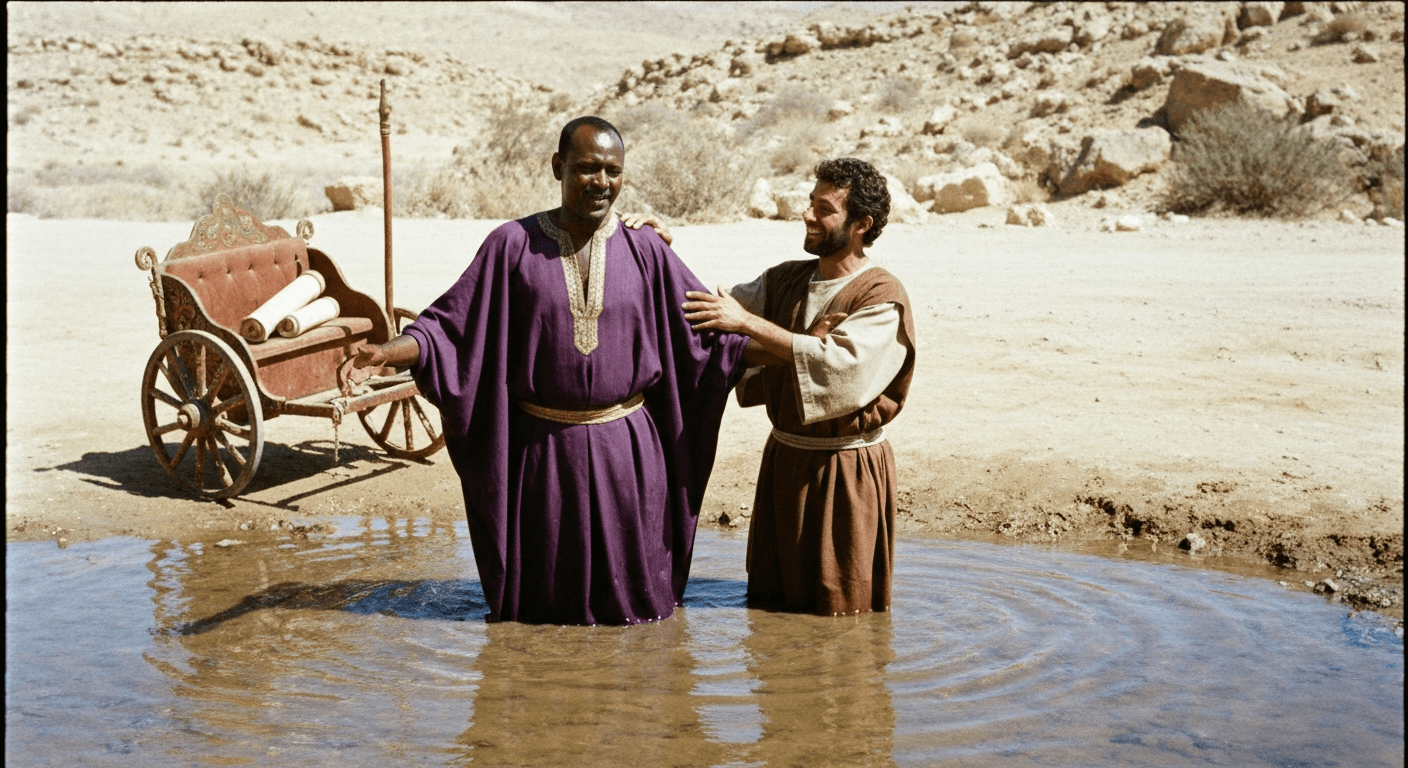
He was a high-ranking financial official in the court of the Kandake — the queen of Ethiopia. He was also a eunuch, which meant that under the religious law he had just travelled hundreds of miles to honour, he was permanently excluded from full participation. He could visit the temple in Jerusalem. He could buy scrolls. He could admire the worship. But he could never fully belong. The law was explicit: no eunuch shall enter the assembly.
The Road from Jerusalem
On the road back to Ethiopia, the eunuch was reading from the scroll of Isaiah in his chariot. A man named Philip appeared alongside the road and asked him if he understood what he was reading. "How can I," the eunuch replied, "unless someone guides me?" Philip climbed into the chariot and explained the passage — Isaiah 53, the description of a man despised and rejected, pierced for the transgressions of others.
The irony would not have been lost on the eunuch. He was reading about a God who identified with the excluded.
The Water and the Decision
As they travelled, they came upon a body of water. The eunuch said something remarkable: "Look, here is water. What prevents me from being baptised?" The question contained his entire life's rejection. Every temple boundary, every religious restriction, every law that told him he was not enough — he was asking Philip whether this new message had the same walls.
Philip's answer was to get out of the chariot and walk with him into the water. The eunuch — a powerful man in fine clothing, riding in an official chariot — stepped down into unknown water on a desert road with a stranger, and was baptised.
The Physical Act of Claiming Belonging
The baptism was the eunuch's physical declaration that the barriers he had lived behind were no longer operational. He did not wait for a temple. He did not wait for a priest. He saw water and he acted. The physical immersion was his body's way of saying: I belong now, and no law can take that from me.
He went on his way rejoicing — the text says so explicitly. A man who had spent his life being told he was not enough had just gotten wet on the side of a road, and it had changed everything.
What This Means for You
If you have ever felt disqualified — by your past, your body, your status, your mistakes — the invitation is the same one the eunuch heard: look, here is water. What stops you? The physical act of stepping in is the act of claiming what was always meant for you.