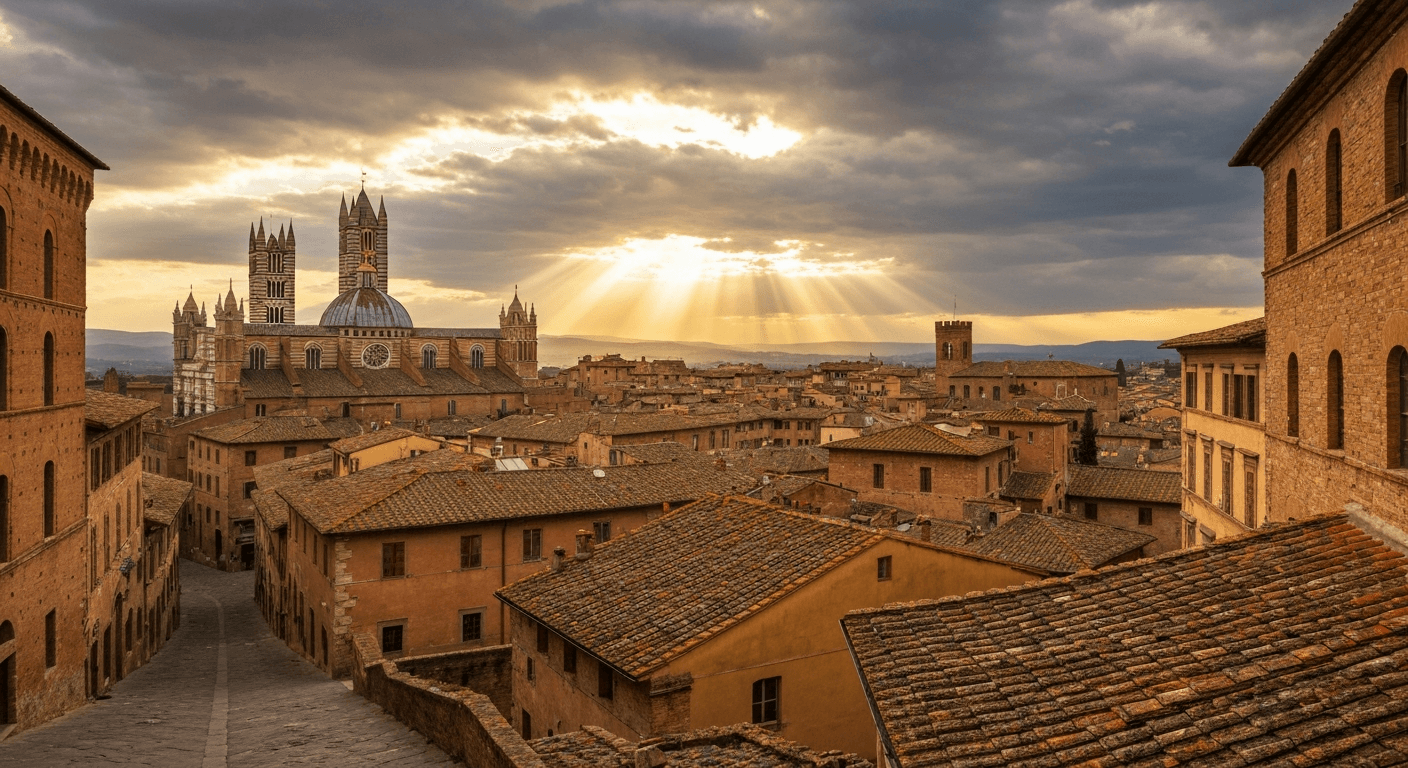
In 1353, a six-year-old girl named Catherine was walking through the streets of Siena with her brother when she suddenly stopped and gazed upward. Her brother called to her, but she did not respond. He finally had to grab her arm and shake her back to awareness.
Child Vision of Jesus
Catherine had seen Christ.
Hovering above the Church of San Domenico, she beheld the Lord Jesus seated in glory like a king, wearing papal vestments, accompanied by the apostles Peter, Paul, and John. As the child stood transfixed, Christ looked directly at her, smiled, and raised His hand in blessing.
In that moment, Catherine later said, she gave her heart to Christ forever.
A Life Transformed by Vision
From that day forward, the daughter of a Sienese wool-dyer became something extraordinary. While other children played, Catherine prayed. At seven, she vowed her virginity to Christ. She began practicing severe penances—sleeping on boards, fasting, wearing rough clothing. Her family, alarmed at her intensity, tried to discourage her. They stripped her of her private room and made her serve as a household servant, hoping drudgery would break her devotion.
It only strengthened it. Catherine discovered she could create an inner cell of solitude where Christ dwelt, untouchable by external circumstances. "Build a cell inside your mind," she later taught, "from which you can never flee."
At sixteen, Catherine joined the Dominican Tertiaries, receiving the habit and beginning three years of near-complete seclusion in her small room. During this time, she experienced increasingly profound visions and conversations with Christ.
Mystical Marriage with Christ
Then came the mystical marriage.
In a vision that would define the rest of her life, the Virgin Mary presented Catherine to Christ, who placed a ring on her finger—visible, she said, only to her own eyes—and called her His bride. "I espouse you to me in faith," Christ said, "that you will keep ever pure until you celebrate your eternal nuptials with me in Heaven."
Transforming Medieval Europe
From that moment, Catherine emerged from her solitude and plunged into the world—nursing the sick during plague, mediating feuds between Italian cities, counseling popes and princes, and dictating letters and her great theological work, The Dialogue, to secretaries who struggled to keep up with her.
She died at thirty-three, worn out by her labors and her penances, but having transformed medieval Europe through the fire that first ignited on a Sienese street when a six-year-old girl looked up and saw Jesus smiling at her.
