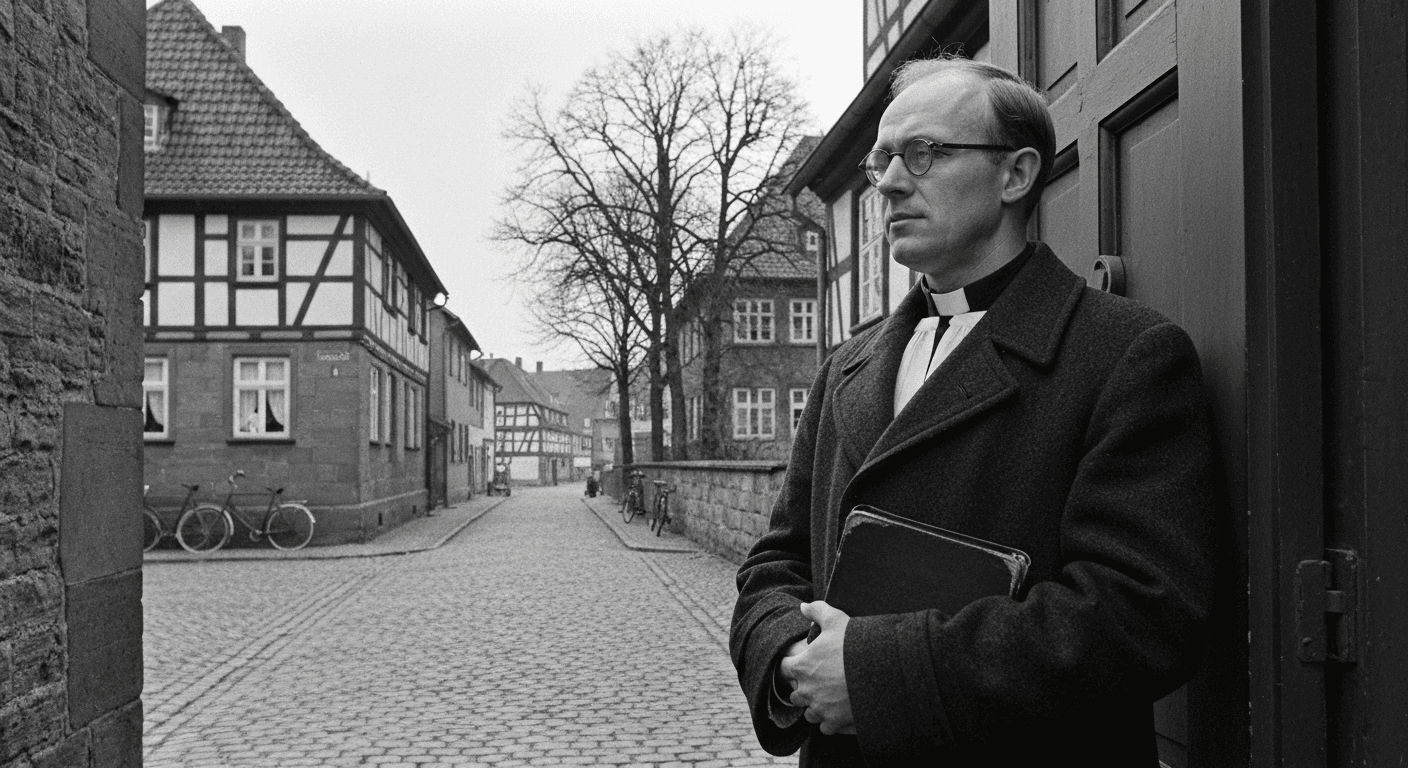
Dietrich Bonhoeffer was a German pastor and theologian who could have sat out World War II in safety. In 1939, friends arranged for him to escape to the United States. He went. He lasted two weeks. Then he boarded a ship back to Germany, writing to Reinhold Niebuhr: "I shall have no right to participate in the reconstruction of Christian life in Germany after the war if I do not share the trials of this time with my people."
The Cost of Seeing Clearly
Back in Germany, Bonhoeffer joined the Abwehr — the German military intelligence service — as a double agent working with the resistance. He helped smuggle Jews to safety through Operation 7. He participated in plots to assassinate Hitler, including the famous July 20, 1944 conspiracy.
He was fully aware of the theological contradiction. A pacifist by conviction, he concluded that refusing to act against a government committing genocide was itself a moral failure. "Silence in the face of evil is itself evil," he wrote. "Not to act is to act."
Arrest, Imprisonment, and Execution
Bonhoeffer was arrested in April 1943 and spent two years in Nazi prisons, including Tegel and Flossenburg. His letters from prison — later published as Letters and Papers from Prison — became some of the most influential theological writing of the twentieth century. He wrote about "costly grace," about the church's responsibility to speak for those who had no voice.
On April 9, 1945 — three weeks before the camp was liberated by Allied forces — Bonhoeffer was executed by hanging at Flossenburg concentration camp. He was 39 years old.
What This Means for You
Bonhoeffer's story demolishes the idea that faith and justice are separate categories. He didn't resist the Nazis despite his faith — he resisted because of it. The question he left behind isn't theoretical. It's urgent: what injustice are you currently positioned to see that others can't?