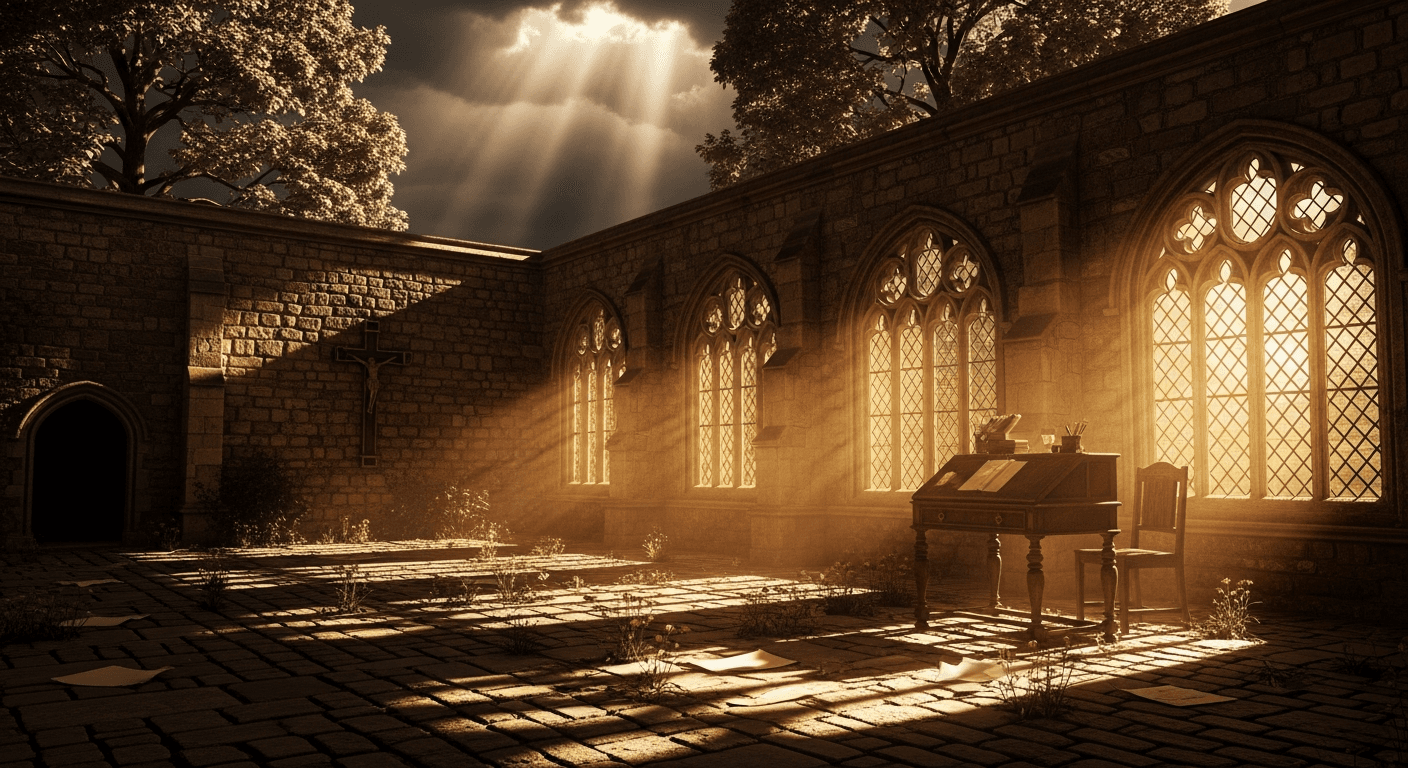
Gerard Manley Hopkins burned his poetry when he became a Jesuit priest, believing the pursuit of literary fame incompatible with religious vocation. Yet God would not let him remain silent. The tension between his calling to priesthood and his calling to poetry produced some of the most extraordinary religious verse in the English language.
From Oxford to Catholic Faith
Born in 1844 to a prosperous Anglican family in Essex, Hopkins showed precocious artistic and literary gifts. At Oxford, he fell under the influence of John Henry Newman and the Oxford Movement. After intense spiritual struggle, Hopkins was received into the Catholic Church in 1866—a decision that grieved his family deeply.
Sacrificing Poetry for Priestly Calling
"I have been elected by Our Lord to be his servant," he wrote, "and to be a poor servant." Two years later, he entered the Society of Jesus. At his novitiate, he burned his early poetry, believing he must sacrifice this talent for God. For seven years, he wrote almost nothing.
God Rekindles the Poetic Gift
Then in 1875, five Franciscan nuns drowned in a shipwreck—exiled from Germany for their faith. Hopkins felt compelled to write. With his superior's blessing, he composed "The Wreck of the Deutschland," a revolutionary poem that invented new rhythms ("sprung rhythm") to capture the overwhelming experience of divine presence in tragedy.
This breakthrough opened the floodgates. Over the following years, Hopkins produced poem after poem celebrating God's presence in creation: "The world is charged with the grandeur of God. / It will flame out, like shining from shook foil."
Finding God in All Creation
His concept of "inscape"—the distinctive essence of each created thing—became his way of seeing God's presence everywhere. Every kingfisher, every hawk, every bluebell revealed its Creator: "Christ plays in ten thousand places, / Lovely in limbs, and lovely in eyes not his / To the Father through the features of men's faces."
Yet Hopkins also knew darkness. His later sonnets—the "terrible sonnets"—express spiritual desolation with devastating honesty: "I wake and feel the fell of dark, not day... / I am gall, I am heartburn. God's most deep decree / Bitter would have me taste: my taste was me."
Hopkins died in 1889 at forty-four, virtually unknown as a poet. His friend Robert Bridges published his collected poems only in 1918. Recognition came slowly, but today Hopkins is recognized as one of the greatest poets in English—a priest who found that his artistic gift and his priestly calling were not in opposition but were two expressions of the same love.
