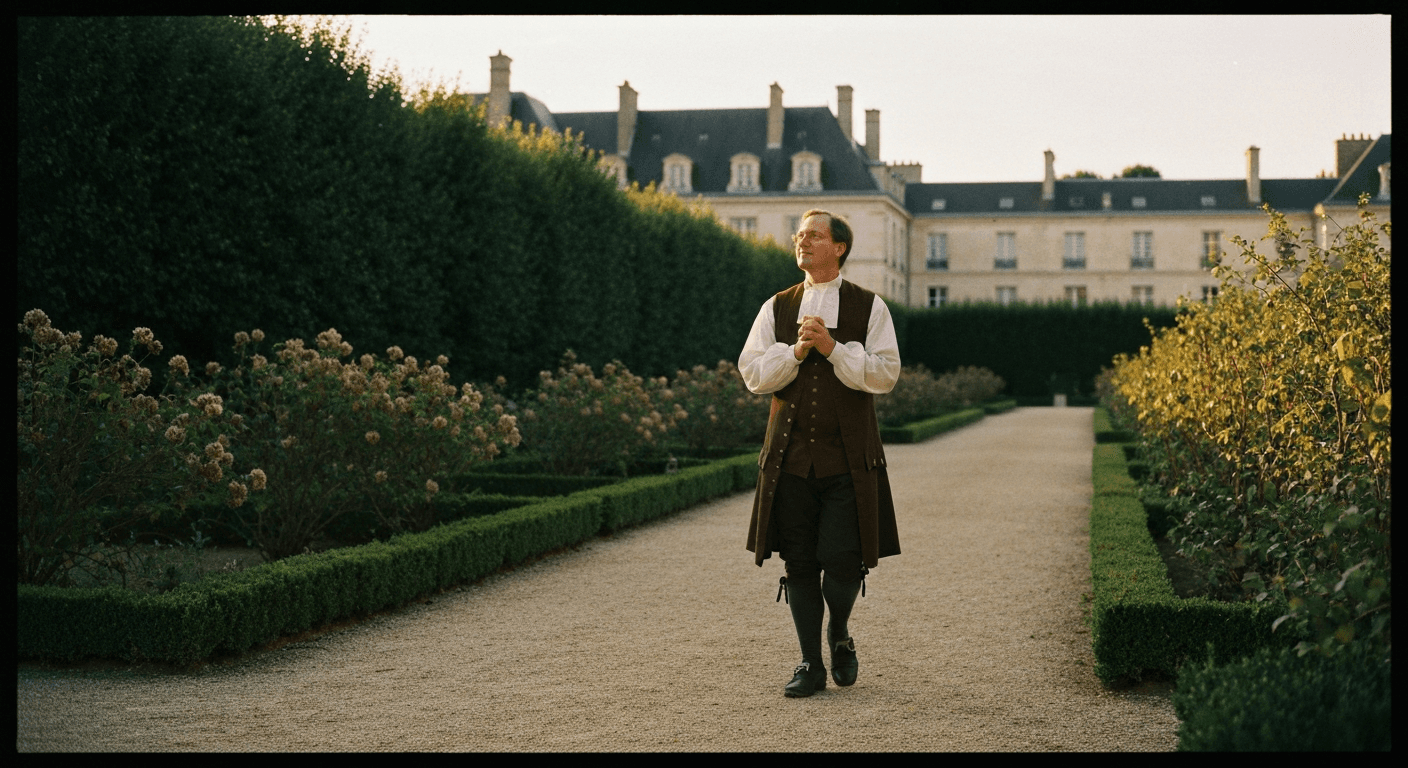
Jean-Pierre de Caussade was an 18th-century Jesuit priest and spiritual director in France. He spent decades guiding nuns and laypeople in prayer. He wrote letters. He gave talks. He was competent, respected, and mostly forgotten by the time he died in 1751. Until his letters were rediscovered and published, nearly a century later, as "Abandonment to Divine Providence."
An After-Lunch Walk
Caussade didn't write about his own experiences often — he considered himself a guide, not a subject. But scattered through his letters is a recurring theme drawn from his own life: the discovery that God was most present to him not during formal prayer or Mass, but during ordinary transitions. Walking through the monastery garden after lunch. Moving from one room to another. The spaces between activities.
He described these moments as what he called "the sacrament of the present moment." Not a theological concept he invented at his desk. Something he noticed while walking past rose bushes after eating bread and cheese.
The Present Moment as Sacred
Caussade's insight was that every single moment — not just the obviously spiritual ones — carried the full weight of God's presence. The problem, he said, wasn't that God was absent from ordinary life. The problem was that people kept looking past the present moment toward some imagined future encounter.
"The present moment is always full of infinite treasure," he wrote to a nun who was struggling with spiritual dryness. "It contains far more than you are able to hold." He'd learned this not from books but from an after-lunch walk.
No Technique Required
What set Caussade apart from other spiritual writers was his insistence that no special technique was needed. You didn't need to learn a method. You didn't need to follow steps. You just needed to stop treating ordinary moments as obstacles to get past on the way to something more spiritual.
What This Means for You
Caussade's message is almost annoyingly simple: this moment — right now, reading this — is full of God. Not the next moment. Not the one you're planning for. This one. The after-lunch walk, the morning commute, the wait in the queue. If you could actually believe that, it would change everything. Caussade did believe it. And it did.
