The Inventions of God
John Muir, born on April 21, 1838, in Dunbar, Scotland, was raised in a strict Calvinist household where his father enforced the memorization of large portions of the Bible. This upbringing, while rigorous, laid the foundation for his deep spiritual life. However, it was not until a life-altering accident at a carriage-wheel factory in Indianapolis that Muir decided to abandon his pursuit of mechanical inventions. In 1867, he determined to 'devote the rest of my life to the study of the inventions of God,' embarking on a 1,000-mile journey from Indiana to Florida.
God's Beauty Made Manifest
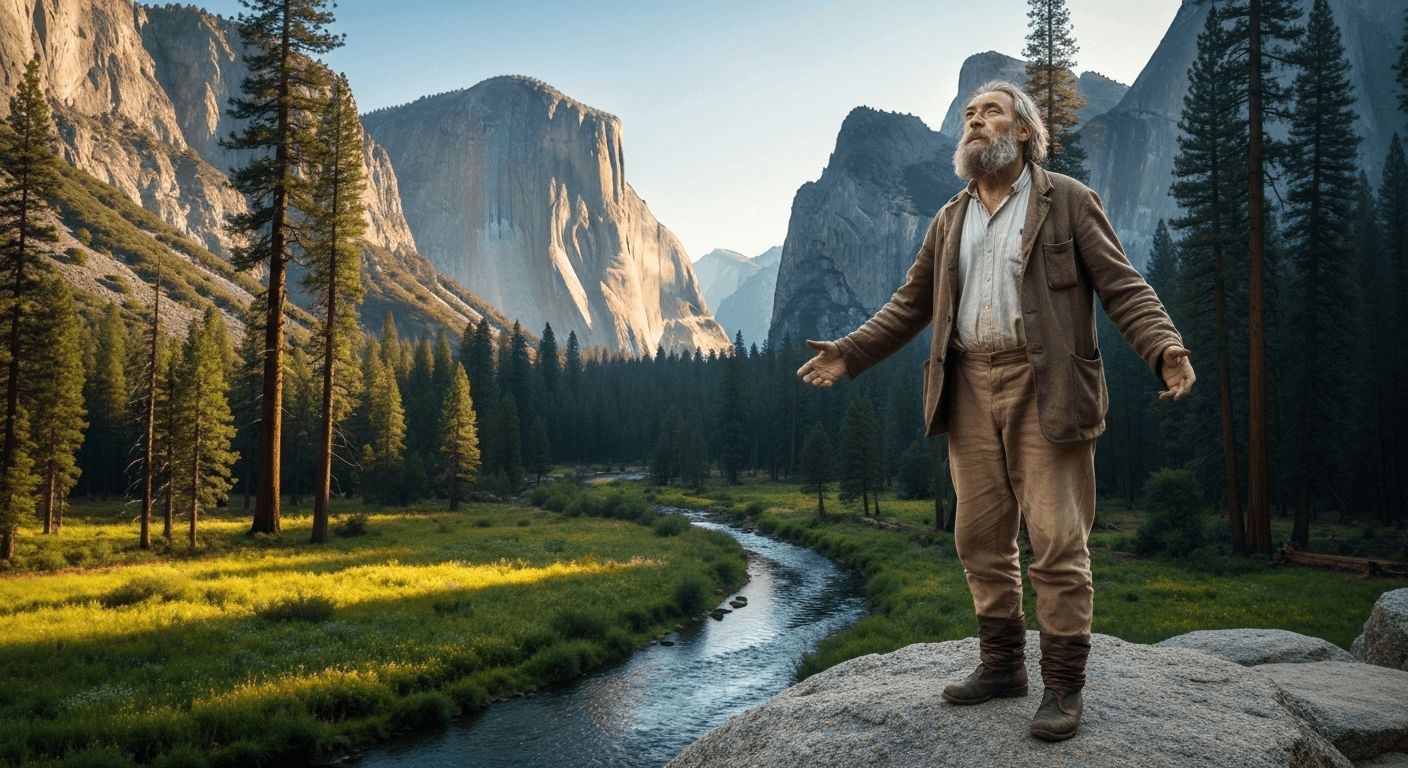
In 1868, Muir arrived in California and settled in Yosemite, where he found what he described as 'God's beauty and love made manifest.' As he explored the wilderness, he encountered God's presence in a way that transformed his understanding of faith. Muir wrote, 'In God's wildness is the hope of the world,' and he saw the wilderness as a place of repentance and restoration, a church where the soul could truly worship.
The Church of the Wilderness
Muir's experiences in nature led him to believe that 'the clearest way into the Universe is through a forest wilderness.' He became a fervent advocate for the preservation of such places, understanding that they revealed God's glory and were essential for the spiritual health of humanity. 'Every particle of rock or water or air has God by its side leading it the way it should go,' he noted, perceiving the divine in every aspect of the natural world.
A Sacred Space
Through his writings and advocacy, Muir inspired others to experience and protect the beauty of nature. His work was instrumental in the establishment of Yosemite National Park in 1890, a testament to his belief that the wilderness was a sacred space, a 'church' where one could encounter God and find peace. Muir's life and legacy continue to remind us of the profound connection between faith and the natural world, urging us to see the divine in all of creation.