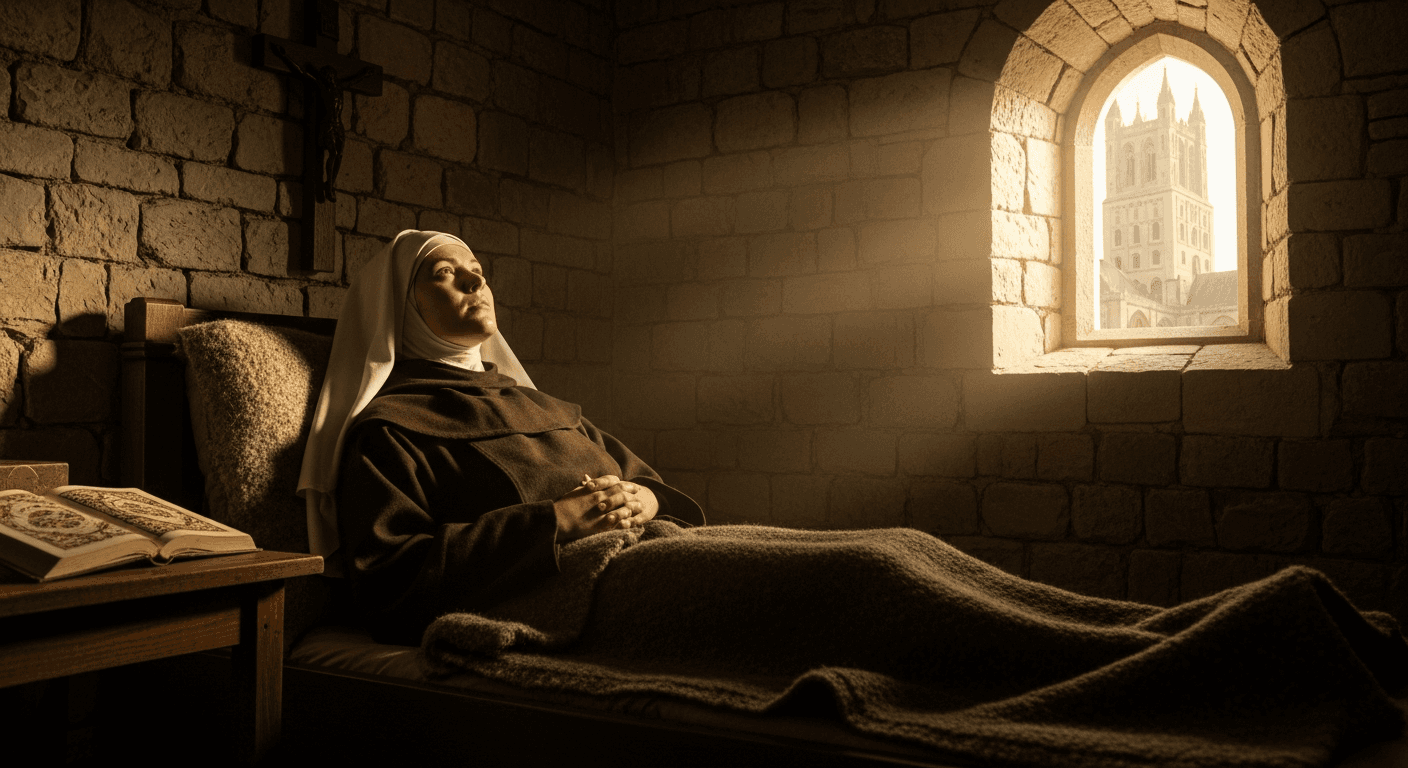
On May 8, 1373, a thirty-year-old woman named Julian lay dying in her small room in Norwich, England. A priest held a crucifix before her failing eyes. She had prayed years earlier for three gifts from God: a vision of Christ's Passion, a bodily sickness to the point of death, and the spiritual wounds of contrition, compassion, and longing for God.
All three prayers were about to be answered.
Divine Visions Near Death
As Julian gazed at the crucifix, the room grew dark until only the cross remained illuminated. Then, suddenly, the figure of Christ came alive. She saw the blood flowing from beneath the crown of thorns, "hot and freshly and right plenteously." Over the next several hours, stretched across what should have been her deathbed, Julian received sixteen separate "showings"—visions of divine love that would take her twenty years to fully understand.
But Julian did not die. Against all expectation, she recovered, and spent the rest of her long life as an anchoress—sealed in a small cell attached to the Church of St. Julian in Norwich—pondering what God had revealed.
Revelations of God's Love
What she saw was revolutionary.
In an age obsessed with divine wrath and the terrors of hell, Julian encountered a God who was nothing but love. "In this he showed me a little thing, the size of a hazelnut, in the palm of my hand," she wrote. "I looked at it with the eye of my understanding and thought: What may this be? And it was answered thus: It is all that is made. I marvelled how it might last, for I thought it might suddenly fall to nothing for littleness. And I was answered in my understanding: It lasts and ever shall, for God loves it."
All Shall Be Well
The central revelation of Julian's visions was captured in words that have comforted countless souls across seven centuries: "All shall be well, and all shall be well, and all manner of thing shall be well."
Julian did not deny the reality of sin and suffering. She wrestled honestly with the problem of evil. But she emerged from her showings convinced that God's love was deeper than any darkness—that the same power that made the universe would ultimately make all things whole.
"He said not: Thou shalt not be tempested, thou shalt not be travailed, thou shalt not be afflicted," Julian recorded. "But he said: Thou shalt not be overcome."
Her Revelations of Divine Love was the first book written in English by a woman. The anchoress who had prayed to know Christ's suffering discovered instead the boundless love that suffering revealed—a love that holds all creation like a hazelnut in the palm of its hand.
