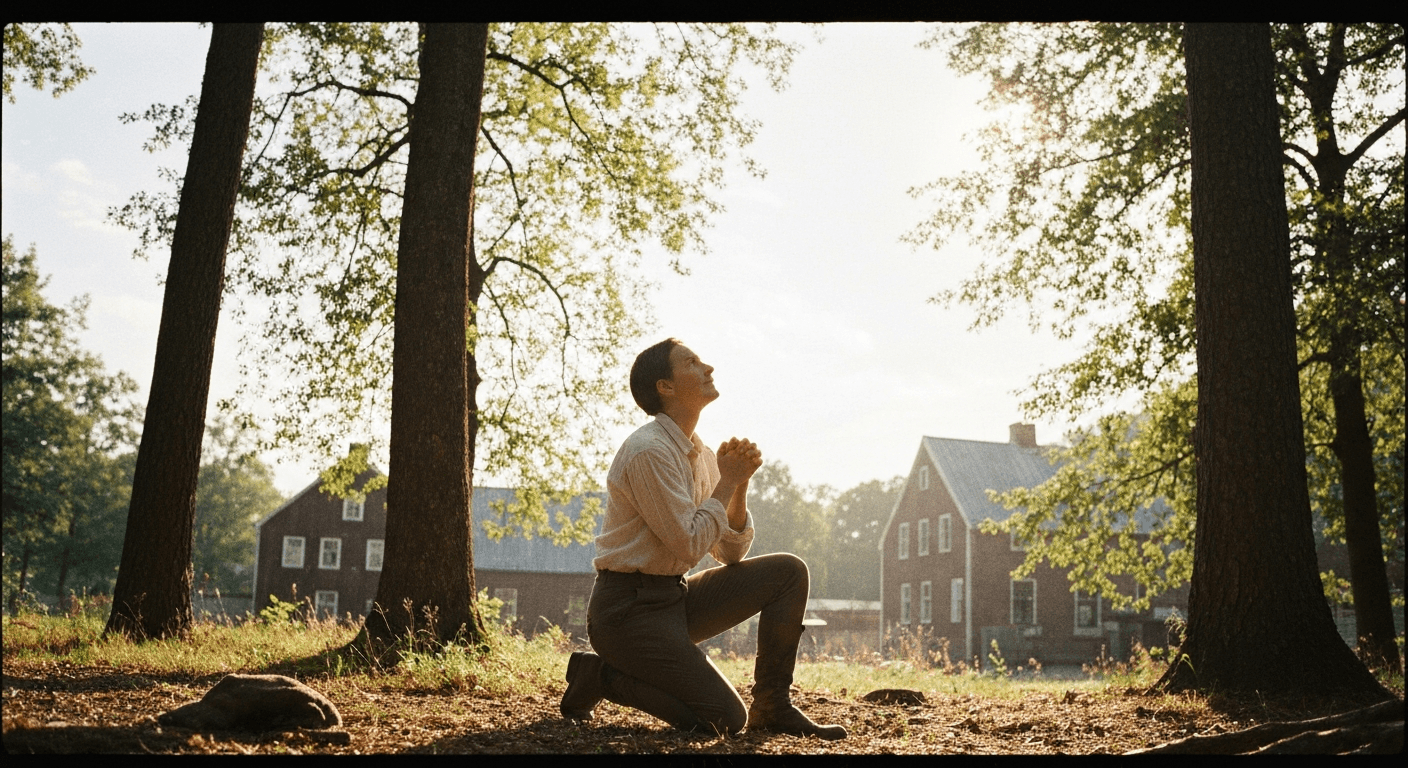
Charles Finney was a successful lawyer in Adams, New York, and a thoroughgoing sceptic. He attended church mostly because the choir director had invited him, and he spent most of his time in the pew quietly dismantling the sermons in his mind. He had no interest in conversion. He had interest in evidence.
October 10, 1821
On a Wednesday morning, Finney left his law office and walked into the woods outside Adams. He had been troubled for weeks by a growing awareness that his intellectual confidence was a facade covering a much deeper restlessness. He found a clearing, knelt on the ground between two fallen trees, and told God that he would not leave until something resolved.
The Physical Act of Kneeling
The kneeling was significant. Finney was a man of standing — a lawyer, articulate, accustomed to being the one in control of the room. Getting on his knees in the dirt of a forest clearing was an act of physical submission that his mind had been resisting for months. He described it later as the moment his body did what his intellect had been refusing to do — surrender.
He knelt for hours. He wept. He argued with himself. And then, as he described it, something broke. Not an audible voice, but a clarity that flooded through him with the force of a physical wave. He walked out of those woods as a fundamentally different person.
The Aftermath
That evening, back in his law office, Finney experienced what he described as "waves of liquid love" passing through his body for hours. He wept until he had no tears left. The next morning, he told his first client that he could no longer represent him — he had a "retainer from the Lord Jesus Christ." He never practised law again.
Over the next fifty years, Finney became the most influential revivalist in American history. Conservative estimates suggest over 500,000 people made commitments to faith through his ministry. He later became president of Oberlin College, which was among the first to admit both women and Black students.
What This Means for You
There is something about the physical act of kneeling — of lowering yourself, of placing your body in a position of openness rather than defence. It does not earn anything. But it can unlock something that staying comfortable and upright never will.