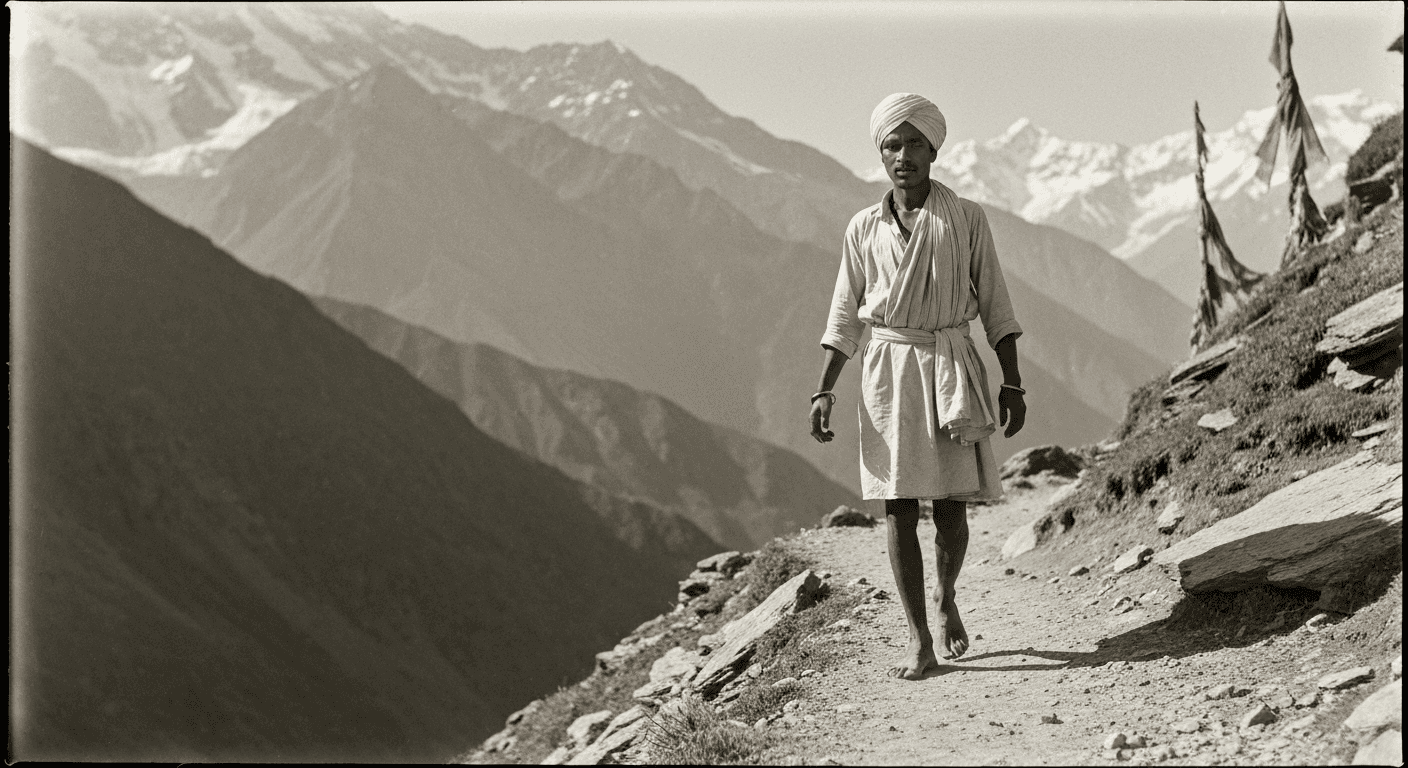
Sundar Singh was born into a wealthy Sikh family in Rampur, Punjab, India, in 1889. By the age of fourteen, he was so hostile to Christianity that he publicly burned a Bible page by page. Three days after the burning, unable to sleep and consumed by an inner turmoil he could not explain, he knelt in his room at 4:30 in the morning and had an encounter with a figure of light that he identified as Jesus. His family disowned him. They poisoned his food. He nearly died.
The Decision to Walk
Rather than establish a ministry, build an organisation, or settle in one place, Sundar Singh chose to walk. He put on the saffron robes of a sadhu — a Hindu holy wanderer — and set out barefoot into the Himalayan passes to share what he had experienced. He carried no money, no provisions, and no shoes. The physical act of walking was the ministry.
The Himalayas as the Crucible
The passes he walked through were above 15,000 feet in places. He walked through snow, through ice, through monsoon rains that washed out trails. He was robbed, beaten, left for dead in a well, and imprisoned in Tibet. He kept walking. For over twenty years, Sundar Singh walked tens of thousands of miles across India, Nepal, Tibet, and eventually Europe and America.
His method was simple: arrive in a village, share his story, accept whatever food and shelter were offered, and walk to the next village. He refused permanent lodging. He refused institutional affiliation. He refused to stop moving. The physical act of walking was his theology — he believed that the gospel had feet, and that those feet needed to be his.
The Encounter Through Movement
Singh described his deepest experiences of God as occurring during the walks themselves — not in the arrivals or the departures, but in the hours of solitary walking through mountain passes. The rhythm of footsteps, the physical exhaustion, the cold that stripped away every comfort — these created what he called "the silence where God speaks loudest."
He disappeared on a final trek into Tibet in 1929, at the age of thirty-nine. His body was never found. He walked into the mountains and did not come back.
What This Means for You
Walking itself can be the spiritual act. Not walking to a destination — walking as the destination. There is something about the rhythm of movement, the commitment of the body, the physical act of putting one foot in front of the other, that opens a door to encounter. Pilgrimage is not about where you arrive. It is about what happens to you on the way.