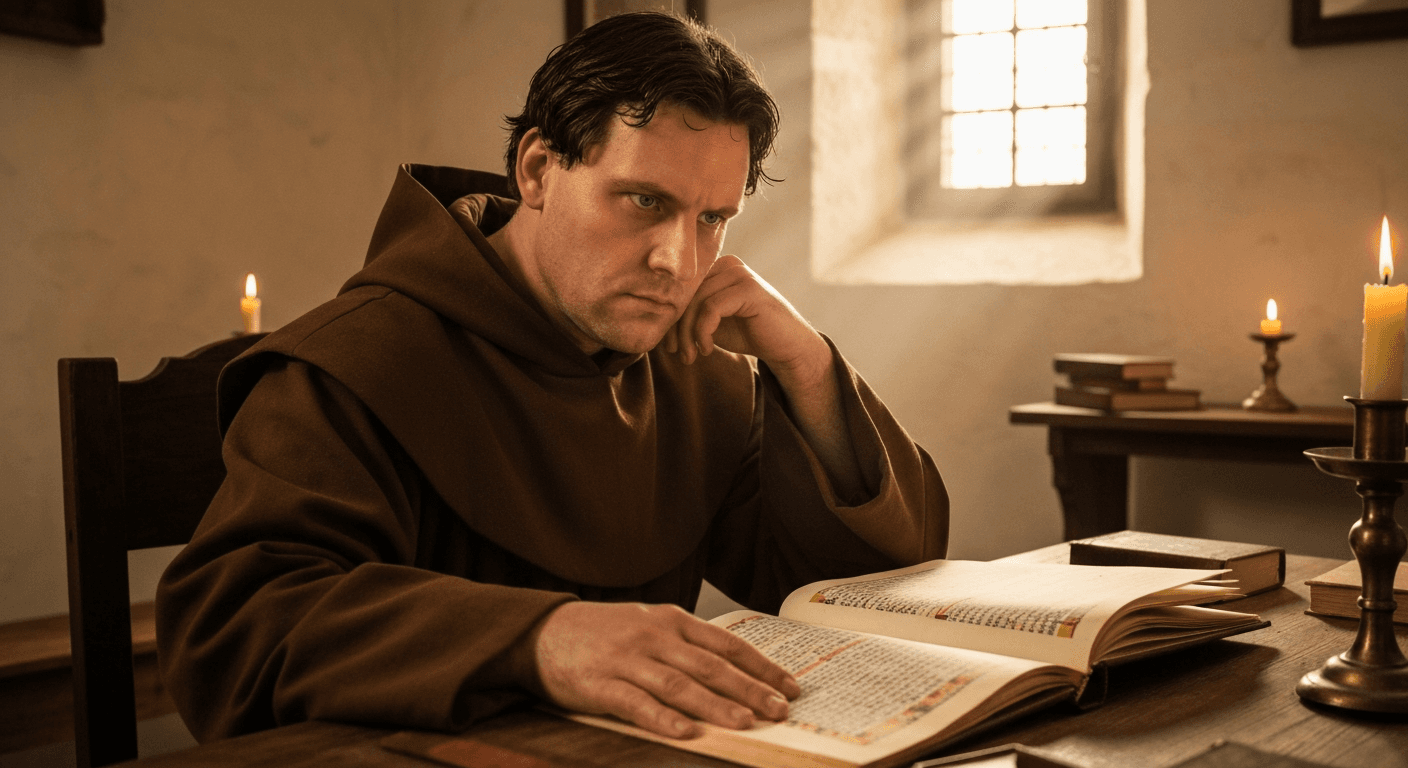
A Monk's Tormented Conscience
Born on November 10, 1483, in Eisleben, Germany, Martin Luther's journey was marked by a relentless pursuit of understanding God's righteousness. Despite living as a devout monk, Luther was tormented by a sense of unworthiness. 'Though I lived as a monk without reproach, I felt that I was a sinner before God with an extremely disturbed conscience,' he confessed. This inner turmoil drove him to seek peace through rigorous monastic practices.
Luther's life took a pivotal turn on July 2, 1505, during a thunderstorm near Stotternheim. Fearing for his life, he vowed to become a monk if he survived. True to his promise, he entered the Augustinian Monastery in Erfurt.
Scripture Reveals Salvation by Faith
Yet, it was his study of the Bible that truly transformed him. 'I greatly longed to understand Paul's Epistle to the Romans,' he wrote, struggling with the concept of 'the justice of God.' It was only after deep contemplation that Luther realized, 'the just shall live by faith.' This revelation, which he later described as feeling 'reborn,' replaced his fear with profound joy and peace.
Bold Stand Against Church Corruption
On October 31, 1517, Luther's newfound understanding led him to challenge the Church's practices by publishing his Ninety-Five Theses in Wittenberg. His boldness continued at the Diet of Worms in April 1521, where he stood firm in his convictions, declaring, 'My conscience is captive to the Word of God.'
Transformed Life Brings God's Word
Excommunicated yet undeterred, Luther sought to bring the Bible to ordinary people by translating it into German while hidden away at Wartburg Castle. Through these actions, Luther not only reformed the Church but also made Scripture accessible to all.
Luther's testimony is a powerful reminder of Jesus' transformative grace. In his own words, 'Lord Jesus, you are my righteousness.' His life and work continue to echo the truth that it is faith in Jesus, not human effort, that brings salvation.