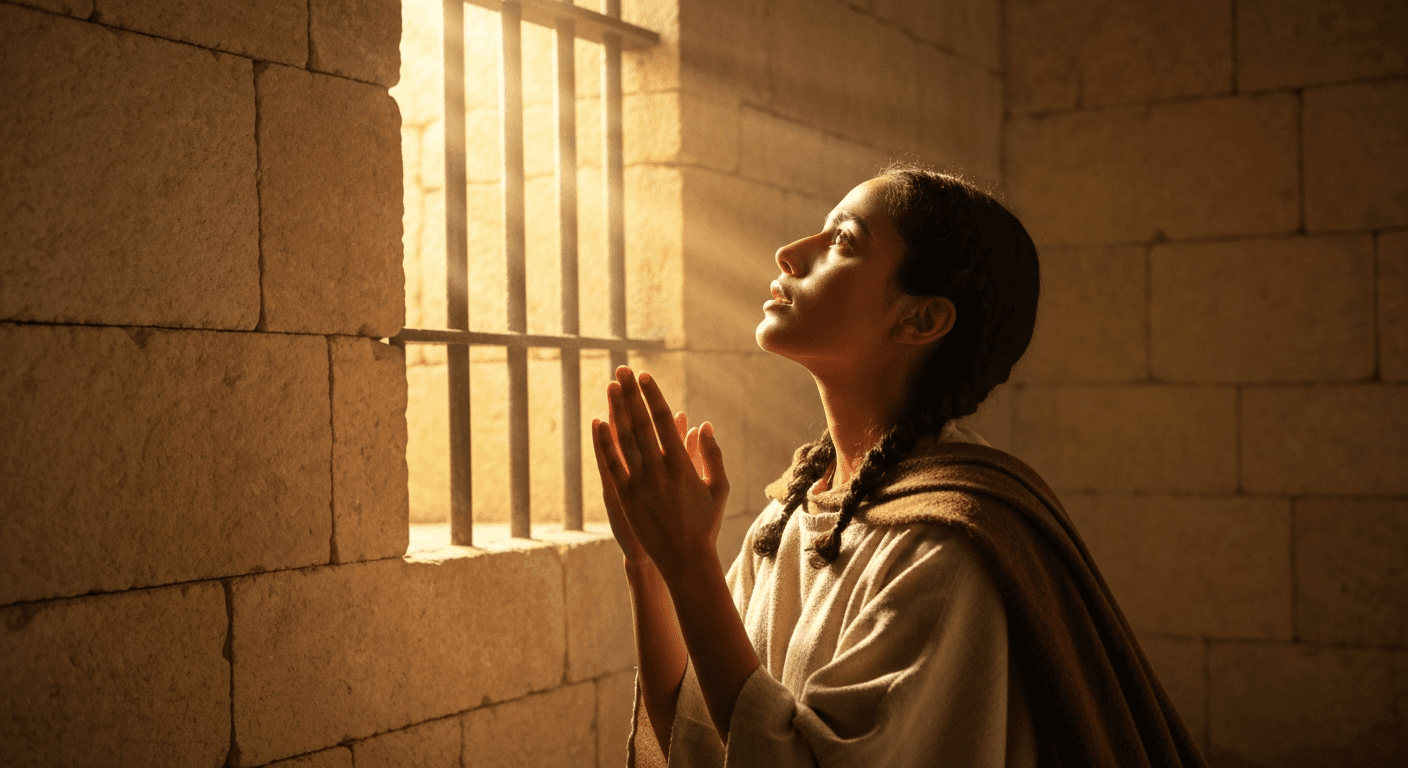
In the year 203 AD, a young noblewoman named Vibia Perpetua sat in a Carthaginian prison, nursing her infant son and writing what would become one of the earliest Christian texts authored by a woman. She was twenty-two years old, well-educated, recently baptized, and sentenced to die in the arena.
Standing Firm Under Pressure
Perpetua's father, a pagan, came repeatedly to the prison, begging her to recant. "Father," she said, pointing to a water pitcher, "do you see this vessel? Can it be called by any other name than what it is?" When he said no, she replied: "Neither can I call myself anything other than what I am—a Christian."
Divine Visions in Prison
In her diary, Perpetua recorded the visions God gave her in prison. In one, she saw a golden ladder reaching to heaven, with a dragon crouching at its base. She stepped on the dragon's head and climbed. At the top, she found a garden where a white-haired shepherd welcomed her with milk and said, "Welcome, child." She understood: she would not be released from prison but would pass through death to life.
Another vision showed her transformed into a man, fighting and defeating an Egyptian—a symbol of the devil himself. "I realized that it was not with wild animals that I would fight but with the Devil," she wrote, "but I knew that I would win the victory."
Perpetua was not alone. With her was Felicitas, a pregnant slave who feared her pregnancy would delay her martyrdom. The group prayed, and Felicitas gave birth two days before the scheduled execution—just in time to face the beasts alongside her companions.
Faithful Unto Death
On March 7, 203 AD, Perpetua and Felicitas entered the arena together. When a wild cow tossed Perpetua, her first instinct was to gather her torn tunic around her and pin up her disheveled hair—"for it was not fitting that a martyr should meet death with hair in disarray, as though mourning in her glory."
When the gladiator's first strike missed her neck and struck her collarbone, she cried out in pain. Then she took the trembling young man's hand and guided the sword to her throat. The eyewitness who completed her diary wrote: "It was as though so great a woman, feared as she was by the unclean spirit, could not be dispatched unless she herself were willing."