The Cave
David, hiddenness, and what God forms when nothing visible is happening
Before the session
Read this through. Come with an honest answer: are you currently in a cave? What does it look like? How long have you been there?
A prophet and a song
A teenager is tending his father's sheep in the hills of Judah. His name is David. An old prophet named Samuel shows up at the house, one day, unannounced, and pours a horn of oil over David's head in front of his brothers. This is the future king.
That is a big prophecy.
And then, for the next fifteen or so years of his life, David does not become king.
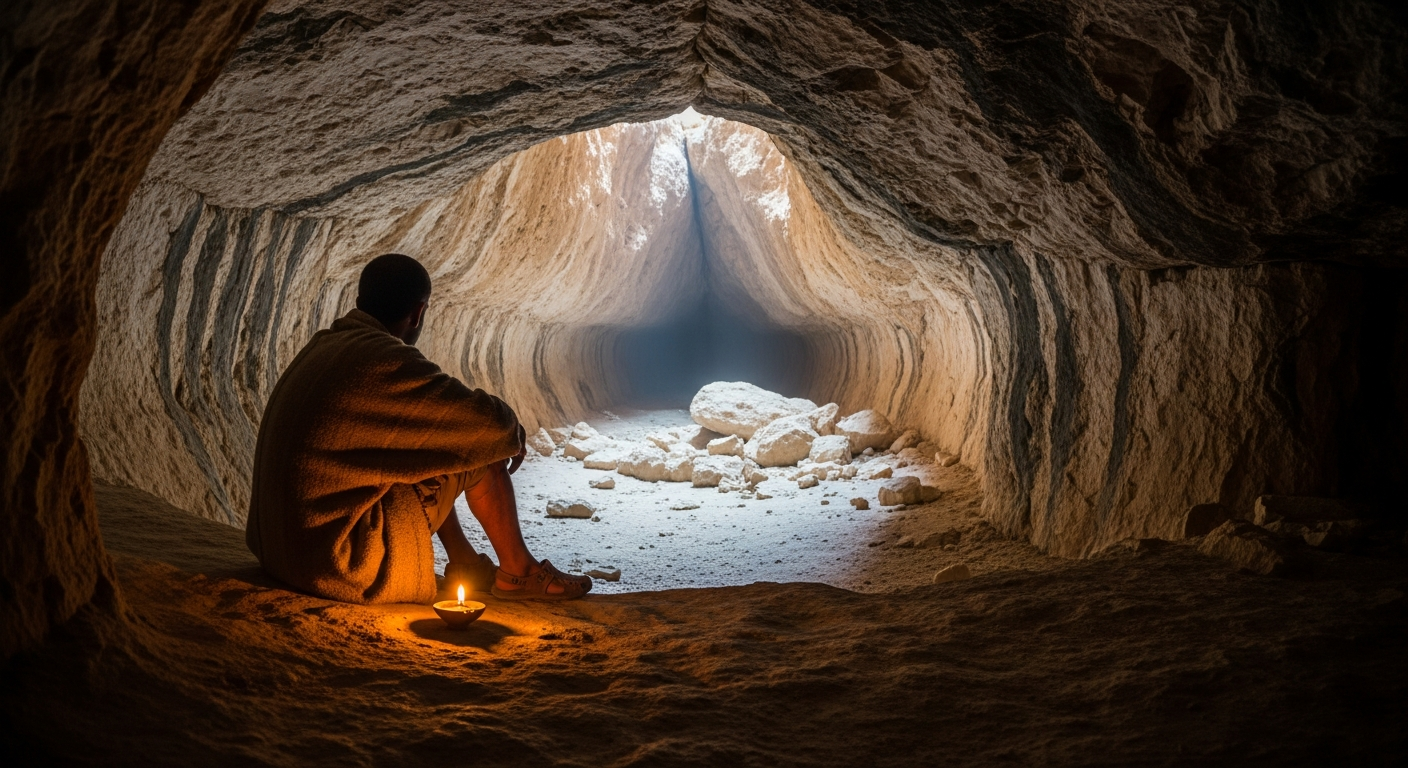
He plays the harp for a king who grows to hate him. He defeats a giant and watches the national praise he earned turn into royal jealousy. He marries the king's daughter and has to flee his own wedding bed with a spear thrown at his head. He runs. He hides. He lies to a priest. He feigns madness in front of a Philistine ruler. He ends up, in 1 Samuel 22, in a cave.
David departed from there and escaped to the cave of Adullam. (1 Samuel 22:1)
And look at who joins him there:
And when his brothers and all his father's house heard it, they went down there to him. And everyone who was in distress, and everyone who was in debt, and everyone who was bitter in soul, gathered to him. And he became commander over them. And there were with him about four hundred men. (1 Samuel 22:1-2)
This is who God trains kings with. The distressed, indebted, bitter-of-soul. Four hundred men who would become, years later, his mighty ones. A future king being formed in a cave with a ragtag band of nobodies.
Now read this again: David had been anointed. He had heard from Samuel. He was a prophetic promise walking. And he was in a cave.
The word most of us want to hear
Most of us, when we receive a word from God, secretly expect a trajectory that goes like this:
Hear the word. → Feel inspired. → Move quickly toward fulfilment. → See the word happen. → Give God thanks on the other side.
The actual biblical trajectory almost always looks more like this:
Hear the word. → Feel inspired. → Begin to move. → Everything slows down. → Circumstances contradict the word. → Cave. → Prison. → Years pass. → Something forms in you that could not have formed any other way. → Fulfilment arrives, later and different than expected, and mostly in a way that makes God famous rather than you.
The cave is not a detour. It is the curriculum.
Why caves form kings
There are a few things that can only be formed in caves. These are the things God does in you while nothing visible is happening:
Character that can handle power. The David who walks out of the cave is different from the David who walked in. He has learned to wait. He has learned to spare Saul when Saul is in his hand. He has learned that God, not his own striking, is the one who puts kings on thrones.
Loyalty to God when nothing is on the line. In the cave, worship is private. There is no crowd. No platform. No return. You either love God when no one is watching or you don't. The cave reveals this, and over time, deepens it.
The capacity to lead the broken. David does not gather the competent and the connected in the cave. He gathers the distressed, the indebted, the bitter. These are the ones who become his mighty men. A king who was formed only on the throne could not lead these people. A king who was formed in a cave can — because he understands them.
Songs. Most of the Psalms were written from cave-shaped seasons. If David had not been hidden, we would not have the psalter. Some of what God does in you in the cave is not for your sake. It is for the generations that will read what you wrote from the cave, for the rest of time.
The cave is not punishment
This is the part most of us get wrong.
We enter a hard season and immediately go scanning: what did I do wrong? What sin opened this? What am I being punished for? Sometimes there is a real answer. Often there is not. Sometimes the cave is not discipline. It is formation.
God forms people in caves He could have kept them out of. Job was blameless. Joseph was righteous. David was anointed. Paul was on mission. Every one of them ended up in some kind of cave or prison for seasons God could have prevented and chose not to.
This does not mean the cave is pleasant. Read the Psalms. David complains, weeps, accuses, rails, despairs. He is honest in the cave. God does not ask him to pretend.
But the cave is not God withdrawing. The cave is God at work in a way that is not visible yet.
What usually happens to us in a cave
There are predictable temptations.
- Cynicism about the word. "Maybe I made it up." "Maybe it wasn't as specific as I remember." "Maybe God changed His mind." The longer the cave, the stronger this gets.
- Quiet bargaining. "If I do this for God, He'll release me from the cave." God is not a vending machine. The cave ends when it ends.
- Trying to exit early. David had two chances to kill Saul in the cave and become king immediately. Both times he refused. Early exits from caves usually end badly.
- Losing the word altogether. This is why course one was about recording. If you lose the word in the cave, you have nothing to hold. Paul told Timothy to fight with the prophecies previously made. Not the vague sense that maybe God once said something.
- Isolation. The cave is lonely. Believers are tempted to drift from church, friends, accountability. David had four hundred men with him in the cave. You need a handful of people who know where you are.
What to do in the cave
This is the practical part. When you find yourself in one:
1. Bring the word with you. Read it aloud. Weekly at minimum. Declare it the way we practiced last week.
2. Keep writing the Psalms. Not literally. But the practice: honest prayer, complaint, hope, declaration — all in the same breath. Write it down. You will need it later.
3. Stay in the body. Do not run from your people. David's loneliness was not total. He had the four hundred. Have your handful.
4. Watch for the formation. What is God forming in you that could not form on the throne? You will not see it all clearly while it is happening. But some of it you will notice.
5. Do not try to end the cave. You cannot shorten formation. Every attempt to exit early lengthens the cave.
6. Worship. Even poorly. Especially poorly. The worship of the cave is more valuable to God than the worship of the throne. No one is watching.
A final honest word
Some of you are in a cave right now. You did not come to this session to hear that your cave is beautiful and good and full of hidden meaning. You came because you are tired. Some of you have been in this cave for years.
Hear this plainly: God has not forgotten. The word has not expired. What is forming is real, even though you cannot see it. And the cave does end.
David spent years in Adullam. He did become king. And his story begins, in 1 Chronicles 11, by listing the names of the mighty men — these were the men who came to him at the cave of Adullam. The cave was not an interruption of his story. It was the origin of his army.
Your cave may be the origin of things you cannot yet see.
Before you come to the session
- Name your cave. One honest sentence.
- Answer: what is God forming in me that could not be formed on the throne?
- Bring the word from last week. We will speak it again.
For Facilitators
The full facilitator edition, with teaching notes, session outlines, and prayer prompts for every week, is available as a downloadable PDF and readable on the web.
Open facilitator editionStart building a culture of remembering.
When your community remembers together, everything gets stronger.
Private groups, shared encouragement, real testimonies. Free to start, in your browser, no card needed.
Free to start. No account needed until you create your church.