The Tower of Babel: Why God Came Down to Scatter Them (Genesis 11:1-9)
Day sixteen of a walk through the whole Bible to know the God who speaks. The whole earth has one language and one plan, a tower to the heavens and a name of their own. Genesis 11:1-9, why a united people building upward is the reverse of trusting the God who had already told them where to go, what it means that the LORD came down to a tower meant to reach Him, and how the scattering of Babel is answered at Pentecost.
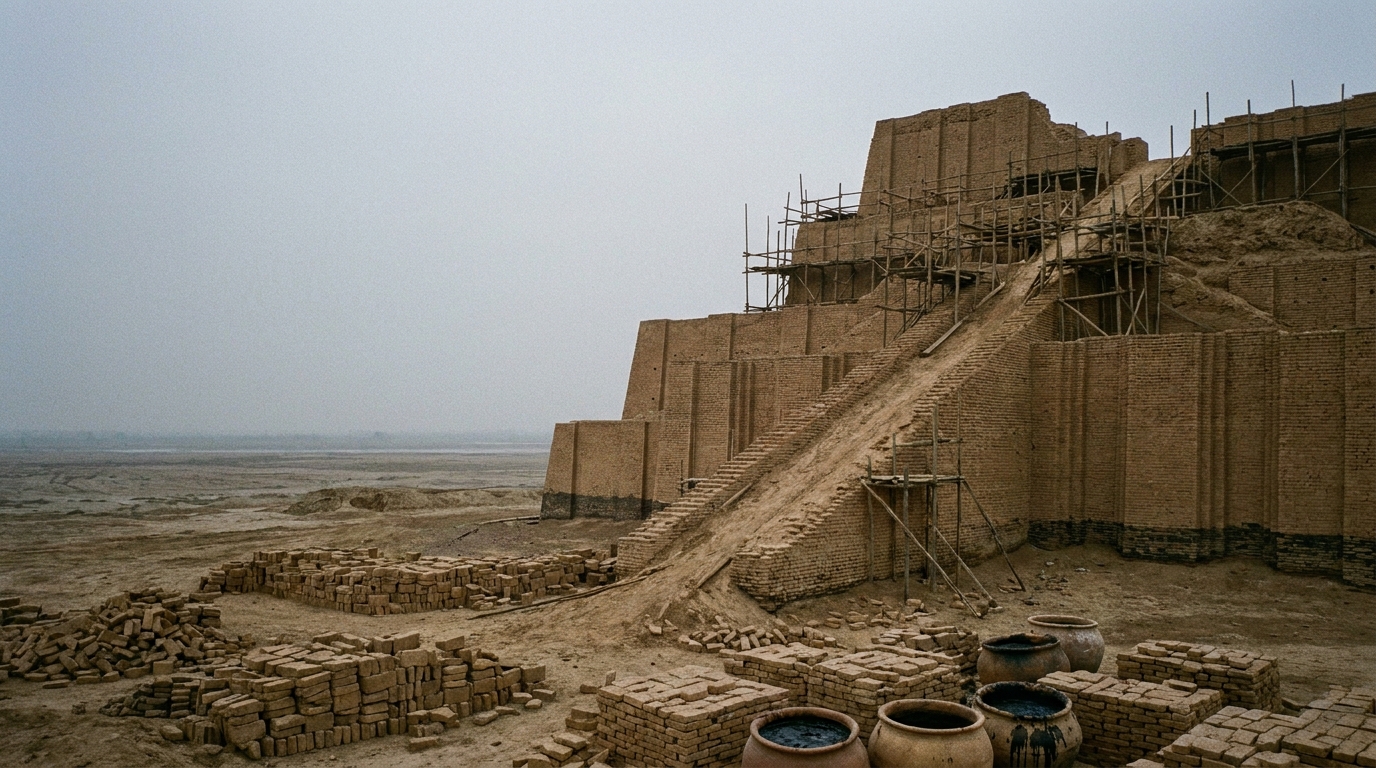
The whole world spoke one language, and the people were on the move. They came to a plain in the land of Shinar and settled, and someone said, let us make bricks and bake them hard. Then the plan grew. They said to one another, "let us build for ourselves a city with a tower that reaches to the heavens, that we may make a name for ourselves and not be scattered over the face of all the earth" (Genesis 11:4).
Read that last line slowly, because it is the whole problem. God had already told this family what to do. He blessed Noah as he came off the ark: "Be fruitful and multiply and fill the earth" (Genesis 9:1). Fill it. Spread across it. The people at Shinar had that word, and they poured a monument to the reverse of it. They would stay in one place. They would make a name they owned. They would climb to the heavens on a stair of their own baking.
What was really wrong with building the tower?
The problem was the refusal. God had spoken, and a whole civilisation heard Him and decided it would rather not listen. They wanted to be known on their own terms, by a name they made rather than by the God who made them. That is the negative of everything this walk is about. To know God is to take what He has said and shape your life around it. Babel took what God said and built the opposite in brick.
Then comes one of the quietly funny lines in Scripture. "Then the LORD came down to see the city and the tower that the sons of men were building" (Genesis 11:5). The tower was meant to reach the heavens, and God has to come down to find it. From where He sits it is very small. He is not threatened. He sees a people who will do themselves harm with their own unity, and He does the merciful thing. "Come, let Us go down and confuse their language" (Genesis 11:7). "That is why it is called Babel, for there the LORD confused the language of the whole world" (Genesis 11:9). The scattering they were so afraid of is what saves them from themselves.
How does Babel connect to Jesus?
Watch what God does in the very next breath. He walks up to one old man, Abram, and says, "I will make your name great" (Genesis 12:2). The name Babel grasped at, God hands over as a gift, to a man who simply believed Him. And the scattering runs all the way to a room in Jerusalem, where the Spirit falls and Galileans are suddenly heard in every language under heaven, "declaring the wonders of God" (Acts 2:11). At Babel God broke the one language so pride could not finish its tower. At Pentecost He fills every language so the good news can reach every nation those scattered people became. The name we could not build for ourselves is the one God gave His Son, "the name above all names" (Philippians 2:9).
So here is the lift. God offers to know you, and to hold you by a promise you never had to manufacture. The only question is what you will do with what He has said. You can build the reverse of it in brick, or you can write it down and let it stand over your life.
What has God already told you that you have quietly been building around instead of on? Name it today.
Deeper study today in the Doxa Deeper Dive, on the Hebrew wordplay that ties Babel to the word for confusion, the "name" of Shinar set beside the name God gives Abram, and how Pentecost answers this chapter. Read it here.
Continue this pillar
Hear & Recognise
My Sheep Know My Voice: Hearing God and Testing Every Whisper
How to recognise God's voice the way a child knows their mother's, and why every impression must be tested against the person of Jesus.
How to Hear God's Voice: A Practical Guide for Believers
Wondering if God still speaks? A practical, honest guide to hearing God's voice through Scripture, testimonies, and everyday life. No mysticism required.
Knowing the Voice of God in a World Full of Noise
God's voice is not one option among many. In a world of competing voices, how do you discern what the Holy Spirit is saying? Why it matters more than ever.
Next in the practice
Prophesy
Stewarding the words God gives you for others, and yourself.
Continue to ProphesyTry Doxa free
Three free interactions in your browser. No signup required to start.Free on iOS and Android.
Try Doxa Free

Or get the app for unlimited interactions and live voice.
Keep reading
Credited as Righteousness: How Abram Was Made Right (Genesis 15)
Day twenty-five of a walk through the whole Bible to know the God who speaks, opened up. Genesis 15:1-6 in the Hebrew: the shield (magen) and reward (sakar) God names Himself after the battle; the ancient Nuzi custom of adopting a servant as heir that lies behind Abram's worry; and the two words that carry the whole scene, aman, the root of 'amen', the firmness of a child leaning its full weight on arms it trusts, and chashab, the accountant's word for what God enters in the ledger when He counts Abram's trust as righteousness. Why this quiet night is where Scripture defines faith, and how Paul reads it straight through to Jesus.
Abram Believed God: The Night He Counted the Stars (Genesis 15)
Day twenty-five of a walk through the whole Bible to know the God who speaks. Abram is rich and childless, and God comes to him in the dark with a shield, a reward, and a sky full of stars he cannot count. Abram says his ache out loud, God answers with one child and a countless family, and Abram believes Him, the moment Scripture will call the first man credited as righteous for taking God at His word. Why believing what God says, when your life still argues the other way, is how anyone comes to know Him and be counted right with Him.
From the Grace Record
Real accounts of what God has done, drawn from 2,000 years of believers.
The Women Who Lead Iran's Underground Church When the Men Were Taken to Prison
When Iranian authorities imprison male house church leaders, women step forward to lead, teach, and multiply the underground church, making them the backbone of the fastest-growing church movement in the world.
Johann Sebastian Bach - Every Note for God's Glory
Johann Sebastian Bach dedicated his entire musical genius to God's glory, writing 'Soli Deo Gloria' on his compositions and serving as a church musician.
Inside Iran's Underground Church
Iran's underground church is one of the fastest-growing in the world, the Holy Spirit is reaching Muslims through dreams, healings, and secret house churches despite severe persecution.