Your Daily Verse Is Deeper Than You Think
The daily verse in Doxa now opens straight into the original language and the world behind the words. Here is what one verse held underneath.

A verse a day was never meant to be a small thing
A daily verse can slip past you. You read it on a lock screen, you nod, you move on, and by lunchtime you could not tell anyone what it said.
That is not the fault of the verse. It is the fault of how little room we give it.
Because when you actually stop and stand in front of a single line of Scripture, when you ask what it means, where it came from, what the words carried in the language they were first written in, something happens. The verse opens. And what pours out is not information. It is worship.
That is the part that still astonishes me. God has spoken to us in Scripture with such depth that a single sentence can hold you for an hour and leave you more in love with Him than when you started. Every day there is more. The well never runs dry.
Doxa now lets your daily verse do exactly that.
The daily verse, and a door marked "Go Deeper"
Each day Doxa gives you a verse to sit with. Under it there is a short reflection, and a button to read the verse in its full context. That much you would expect.
What is new is the door underneath.
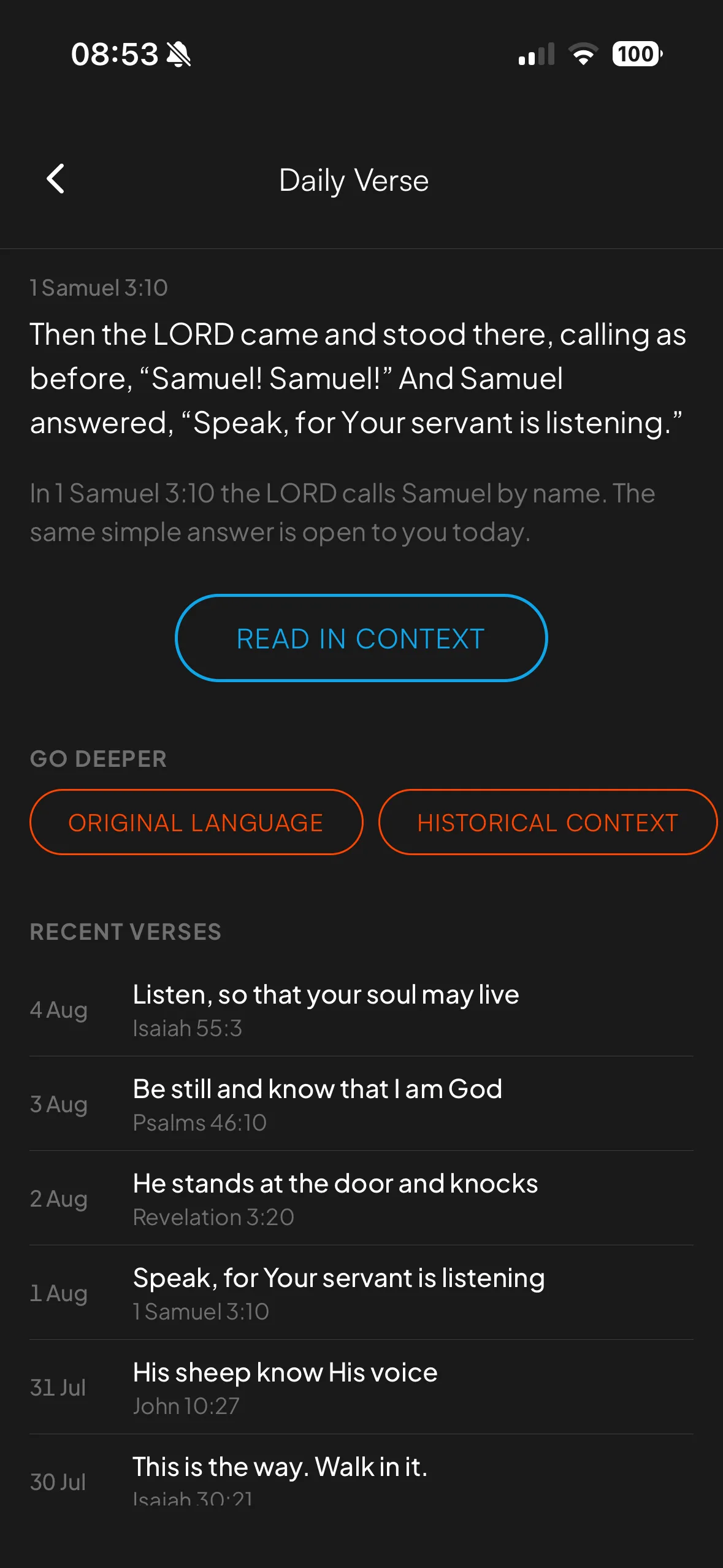
Go Deeper (Original Language and Historical Context) takes your verse into Doxa Engage, the part of Doxa built for studying Scripture closely. One tap and you are no longer reading about the verse from the outside. You can put your real questions to the text and follow them down, as far as you want to go, into the original words and the world they were first written in.
I put it to work on the morning's verse, 1 Samuel 3:10:
Then the LORD came and stood there, calling as before, "Samuel! Samuel!" And Samuel answered, "Speak, for Your servant is listening."
I asked two questions. Here is what it opened up, word for word. I have changed nothing.
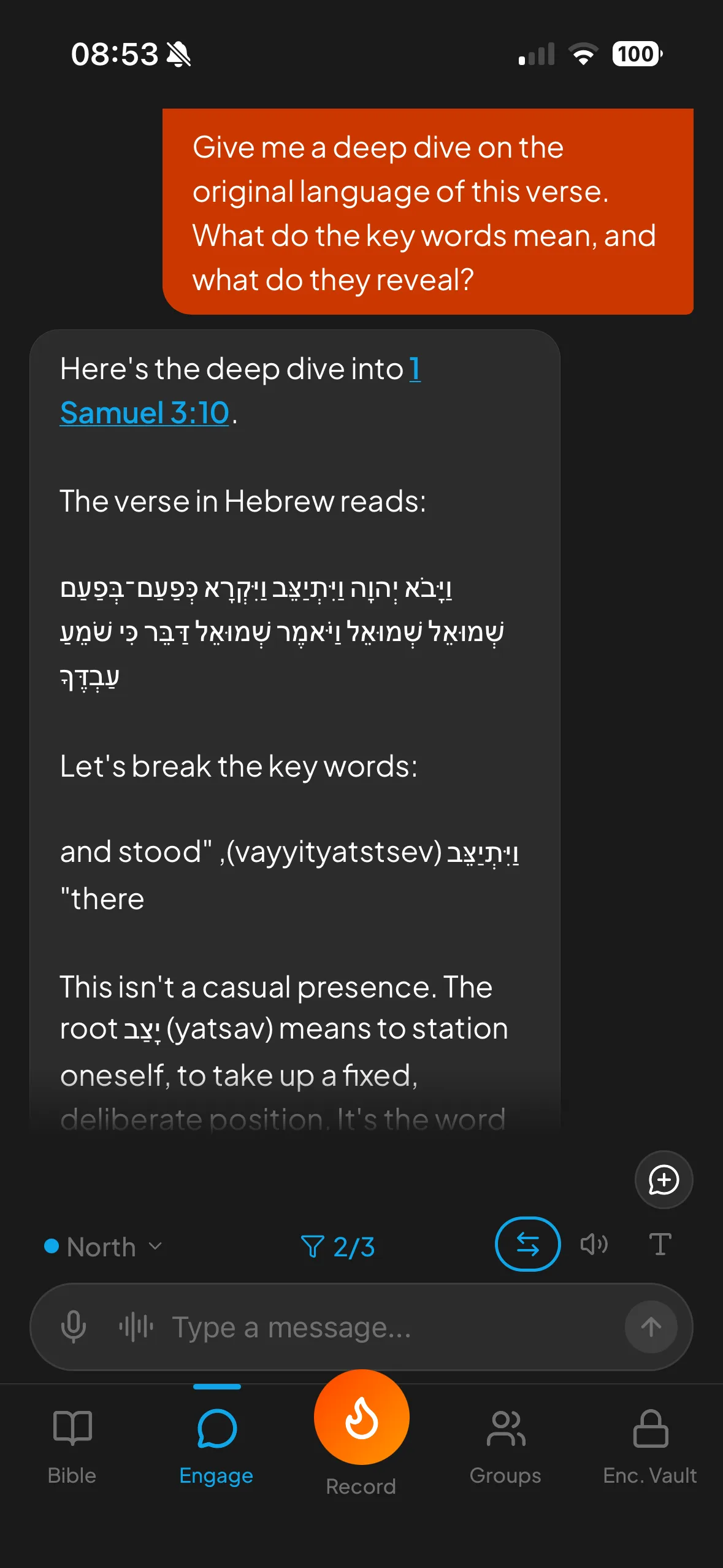
Me: Give me a deep dive on the original language of this verse. What do the key words mean, and what do they reveal?
Doxa: Here's the deep dive into 1 Samuel 3:10.
The verse in Hebrew reads:
וַיָּבֹא יְהוָה וַיִּתְיַצֵּב וַיִּקְרָא כְּפַעַם־בְּפַעַם שְׁמוּאֵל שְׁמוּאֵל וַיֹּאמֶר שְׁמוּאֵל דַּבֵּר כִּי שֹׁמֵעַ עַבְדֶּךָ
Let's break the key words:
וַיִּתְיַצֵּב (vayyityatstsev), "and stood there"
This isn't a casual presence. The root יָצַב (yatsav) means to station oneself, to take up a fixed, deliberate position. It's the word used of a soldier standing post or a person planting their feet firmly. God didn't drift in, He positioned Himself. This is purposeful proximity. The Lord of Heaven came and deliberately stood in that place, before that boy.
שְׁמוּאֵל שְׁמוּאֵל, "Samuel! Samuel!"
The double calling is significant throughout Hebrew Scripture. When God calls a name twice, Abraham! Abraham! (Genesis 22), Moses! Moses! (Exodus 3), Martha! Martha! (Luke 10), it signals urgency, intimacy, and tender precision. This isn't a broadcast. It's a summons of a specific person by name. The repetition says: you, exactly you, are who I'm after.
דַּבֵּר (dabber), "Speak"
Samuel doesn't say "speak if you want to" or "speak and I'll consider it." The word is a Piel imperative, it's a command directed at God, but expressed as an invitation. There's holy boldness in it. Samuel is effectively saying: I am positioned. You may proceed.
כִּי שֹׁמֵעַ (ki shomea), "for Your servant is listening"
This is the heart of it. שֹׁמֵעַ (shomea) is from the root שָׁמַע (shama), which is the most loaded verb in the Hebrew Bible. It doesn't just mean to hear with the ears. It means to hear, attend, obey, and act. The Shema, "Hear, O Israel" (Deuteronomy 6:4), uses this same root. When Samuel says "I am listening," he's pledging more than his ears. He's pledging his will.
And notice the tense, it's a present participle. Not "I will listen." Not "I have listened." I am, right now, in this moment, actively listening. It's a posture, not a promise about the future.
עַבְדֶּךָ (avdecha), "Your servant"
The word עֶבֶד (eved) means servant, but in the ancient Near East it carried deep relational weight. It's the same word used of Moses ("My servant Moses"), of David ("My servant David"). To call oneself God's eved was to place your entire life within His purposes. Samuel isn't just politely available. He's surrendering his agenda entirely.
What does all this reveal?
The verse is a masterclass in the posture of receiving from God. God stations Himself, He initiates, He comes, He speaks the name. Samuel's entire role is one thing: oriented readiness. Not performance. Not striving. Just "I am here, You are speaking, I belong to You."
Eli's coaching in 1 Samuel 3:9 is also worth noting, he told Samuel to say "Speak, LORD", but Samuel drops the divine name. He simply says "Speak." Some commentators see this as the intimacy of the moment overtaking the formality of the formula. Samuel had moved from instruction to encounter.
The whole verse is essentially a portrait of available surrender, and out of it, one of the most significant prophetic ministries in Israel's history was born.
Me: What does the name Samuel mean and what is the significance of it here?
Doxa: Great question, the name itself adds another layer to the whole scene.
The name שְׁמוּאֵל (Shemuel) is almost certainly a compound of two Hebrew elements:
שֵׁם (shem), meaning name, and אֵל (El), meaning God. So one reading is "His name is God" or "name of God", pointing to someone who bears or proclaims God's reputation.
But the more commonly accepted derivation, and the one the text itself anchors to, is שָׁמַע (shama) plus אֵל, "heard of God" or "God has heard." This is the meaning Hannah herself gives in 1 Samuel 1:20, where she says she named him Samuel "So in the course of time, Hannah conceived and gave birth to a son. She named him Samuel, saying, 'Because I have asked for him from the LORD.'" The name is her testimony baked into his identity. Every time someone called his name, they were declaring: God hears. God answers prayer.
Now layer that into 1 Samuel 3:10 and the resonance becomes extraordinary.
The name that means "God heard" is now being called by God Himself. The boy whose very existence was an answer to a desperate mother's prayer is now being summoned into a lifetime of carrying God's voice to a nation. And he responds with the word שֹׁמֵעַ, I am listening, the very root embedded in his own name.
There's a beautiful circular logic here. Hannah prayed, God heard (shama), Samuel was born. Now God speaks, Samuel hears (shama), and a prophet is born.
His name wasn't just biographical. It was prophetic of his entire vocation. Samuel would spend his life being the person through whom God heard Israel and Israel heard God. The name announced the calling before the calling was given.
And when God calls it twice, Samuel! Samuel!, He's not just getting a boy's attention. He's invoking the full weight of what that name means. You whose name is "God hears." I am here. Now listen.
Why this leaves me in worship
Read that back. That is one verse. One line most of us have skimmed a hundred times.
Underneath it was the difference between a soldier drifting past and a soldier planting his feet. A name called twice across the whole of Scripture as a signal of tenderness. A boy whose very name means God hears answering the God who is speaking, with the exact verb buried inside his own name. A mother's prayer, an answered child, a prophet born: all folded into a handful of Hebrew words.
None of that was invented. It was already there, put there by God, waiting in the text for anyone who would stop long enough to ask.
That is the wonder I keep coming back to. God did not give us a flat book. He gave us a living one, layered so deeply that you could spend your whole life in a single chapter and still be finding gold. The freshness never runs out. Every daily verse is a doorway, and behind every doorway is more of Him than you had yesterday.
So awesome. God, You are awesome.
Try it on tomorrow's verse
You do not need to know Hebrew. You do not need a shelf of commentaries. You need one verse, one honest question, and the willingness to stand in front of it a little longer than usual.
Open Doxa tomorrow. Read the daily verse. Then tap Go Deeper, and put your real question to the text, the thing you have always half-wondered. Let it open the original language, the world the verse was written in, the heart of the God who is still speaking through it.
And when a phrase catches fire in you, record it. That is what Doxa is for: not only meeting God in the verse today, but holding on to what He said so it is still burning in you next month.
Keep Reading
- How to Hear God's Voice: A Practical Guide for Believers
- The Spiritual Discipline of Remembering What God Said
- When God Speaks, He Does Not Just Give Instructions
- Why Prophetic Words Fade, and How to Keep Them Alive
Doxa helps you meet God in Scripture and remember what He says. Read your daily verse, go deeper into the original language, record what stirs you, and revisit it when you need it most. Get started free.
Continue this pillar
Hear & Recognise
My Sheep Know My Voice: Hearing God and Testing Every Whisper
How to recognise God's voice the way a child knows their mother's, and why every impression must be tested against the person of Jesus.
How to Hear God's Voice: A Practical Guide for Believers
Wondering if God still speaks? A practical, honest guide to hearing God's voice through Scripture, testimonies, and everyday life. No mysticism required.
Knowing the Voice of God in a World Full of Noise
God's voice is not one option among many. In a world of competing voices, how do you discern what the Holy Spirit is saying? Why it matters more than ever.
Next in the practice
Prophesy
Stewarding the words God gives you for others, and yourself.
Continue to ProphesyTry Doxa free
Three free interactions in your browser. No signup required to start.Free on iOS and Android.
Try Doxa Free

Or get the app for unlimited interactions and live voice.
Keep reading
Credited as Righteousness: How Abram Was Made Right (Genesis 15)
Day twenty-five of a walk through the whole Bible to know the God who speaks, opened up. Genesis 15:1-6 in the Hebrew: the shield (magen) and reward (sakar) God names Himself after the battle; the ancient Nuzi custom of adopting a servant as heir that lies behind Abram's worry; and the two words that carry the whole scene, aman, the root of 'amen', the firmness of a child leaning its full weight on arms it trusts, and chashab, the accountant's word for what God enters in the ledger when He counts Abram's trust as righteousness. Why this quiet night is where Scripture defines faith, and how Paul reads it straight through to Jesus.
Abram Believed God: The Night He Counted the Stars (Genesis 15)
Day twenty-five of a walk through the whole Bible to know the God who speaks. Abram is rich and childless, and God comes to him in the dark with a shield, a reward, and a sky full of stars he cannot count. Abram says his ache out loud, God answers with one child and a countless family, and Abram believes Him, the moment Scripture will call the first man credited as righteous for taking God at His word. Why believing what God says, when your life still argues the other way, is how anyone comes to know Him and be counted right with Him.
From the Grace Record
Real accounts of what God has done, drawn from 2,000 years of believers.
Johann Sebastian Bach - Every Note for God's Glory
Johann Sebastian Bach dedicated his entire musical genius to God's glory, writing 'Soli Deo Gloria' on his compositions and serving as a church musician.
Inside Iran's Underground Church
Iran's underground church is one of the fastest-growing in the world, the Holy Spirit is reaching Muslims through dreams, healings, and secret house churches despite severe persecution.
When the Check Came - George Müller's Orphanages
George Müller cared for over 10,000 orphans in Bristol, England without ever asking anyone for money, trusting only God's provision through prayer.