Why God Told Abram to Walk the Land He Didn't Own (Genesis 13)
Day twenty-two of a walk through the whole Bible to know the God who speaks, opened up. Genesis 13:14-18 in the Hebrew: God telling Abram to lift up (nasa) his eyes, the same verb Lot used to grab the plain; the land given (natan) forever (olam); offspring like the dust (aphar) of the earth, the very word for human frailty made the measure of his abundance; the command to walk (halak) the length and breadth of a land he did not own; and the tent and altar (mizbeach) he answered with at the Oaks of Mamre. Why the man who let go was handed everything, and how Abraham's seed reaches all the way to Christ and to us.
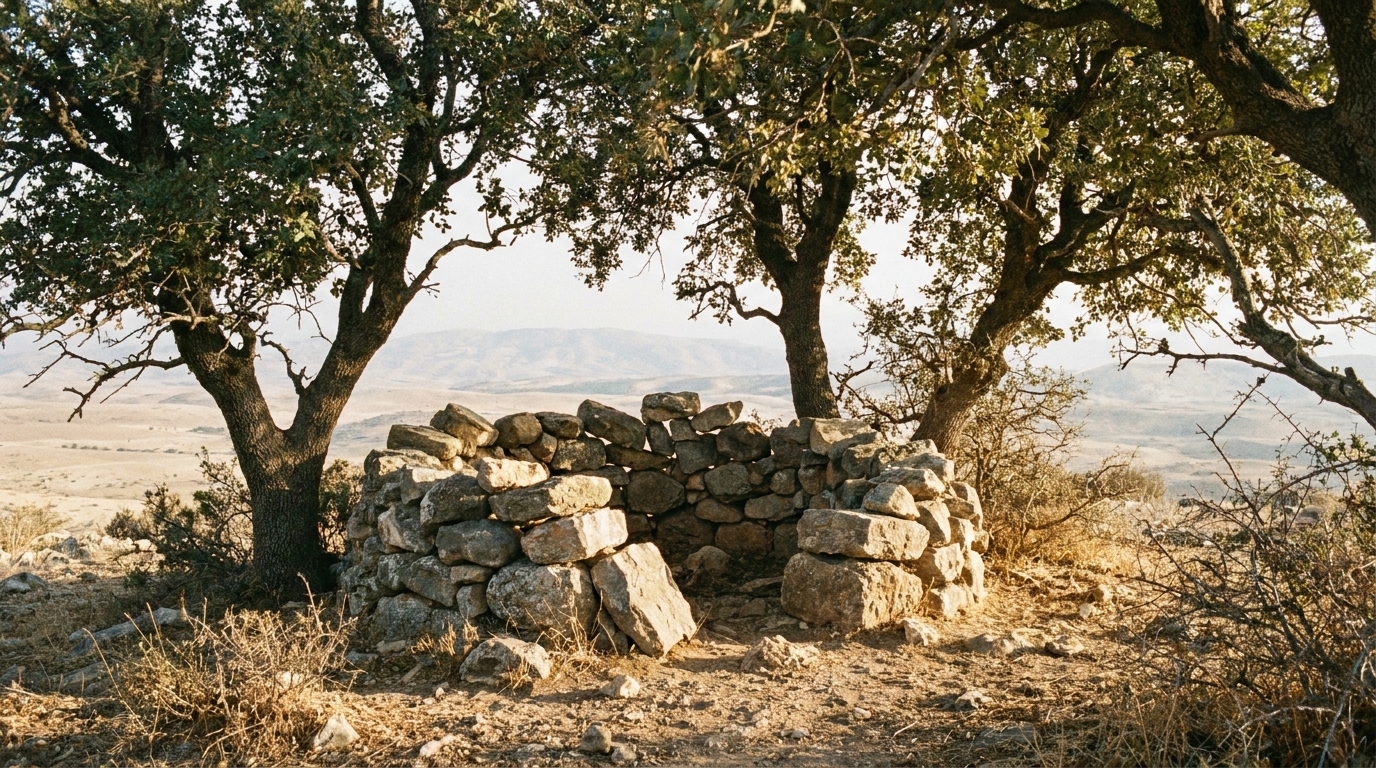
The two households have split. Lot has taken the well-watered plain and gone east, and Abram is left on the higher, drier ground. That is the moment God chooses to speak.
What did God say to Abram after Lot chose the best land?
The scene opens on the timing: "After Lot had departed, the LORD said to Abram" (Genesis 13:14). God waits until the ground is settled, until Abram has already let his nephew walk off with the richest part of the valley, and only then does the promise come. The verb under the whole speech is natan (H5414), to give, the word for a gift freely handed over. The God who speaks simply decides to hand Abram the land. It comes as a pure gift, and the man who opened his hands is the man God fills.
Why did God tell Abram to lift up his eyes?
"Now lift up your eyes from the place where you are, and look to the north and south and east and west" (Genesis 13:14). The Hebrew for lift up is nasa (H5375), and it has already run twice through this chapter. In verse 6 the land could not nasa both households; it could not carry their combined weight. In verse 10 Lot nasa his own eyes and looked out over the plain before grabbing it (Genesis 13:10). The same verb: the land groaning under a weight it cannot bear, Lot raising his gaze to seize, and now God commanding Abram to raise his gaze and receive. The verb paired with it is raah (H7200), to see. Lot saw and chose for himself; Abram is told to see what is being given to him. God turns a grasping gesture into an act of faith by putting His own word behind it.
What does offspring like the dust of the earth mean?
Two promises follow, and both are staggering for a man who is still childless. "For all the land that you see, I will give to you and your offspring forever" (Genesis 13:15). Offspring is zera (H2233), seed, and forever is olam (H5769), a duration that runs past the horizon of a lifetime. Then the measure: "I will make your offspring like the dust of the earth, so that if one could count the dust of the earth, then your offspring could be counted" (Genesis 13:16). Dust is aphar (H6083), the same word Genesis has already used for human smallness. God "formed man from the dust of the ground" (Genesis 2:7), and to dust the sinner returns. God takes the very word for how frail and countless-in-death we are and makes it the measure of Abram's abundance in life. The word for what returns to dust in death is the word He now uses to count a family too large to number.
Why did God tell Abram to walk the length and breadth of the land?
"Get up and walk around the land, through its length and breadth, for I will give it to you" (Genesis 13:17). The verb is halak (H1980) in a form that means to walk to and fro, to range across. In the ancient world walking a territory was a legal act; you took possession of ground by treading its length and breadth in the sight of witnesses. God tells Abram to enact ownership of erets (H776), land, that he holds no deed to and will not hold one to in his lifetime. The only plot Abram ever legally owns is the cave where he later buries Sarah (Genesis 23). Yet he is told to walk the whole of it as already his, because the word of the God who gives is a firmer title than any deed. Abram walks the promise before he sees it fulfilled.
Why did Abram build an altar at the Oaks of Mamre?
"So Abram moved his tent and went to live near the Oaks of Mamre at Hebron, where he built an altar to the LORD" (Genesis 13:18). He is handed a land forever, and he answers with a tent and an altar. The trees are elon (H436), great terebinths, a named and rooted place. The altar is mizbeach (H4196), the place of sacrifice, and Abram banah (H1129), built it, the same word used for building a house. He builds an altar and goes on living in a tent. Mamre becomes the address where the LORD appears to him again (Genesis 18:1) and where he is buried in the end. Building the altar is how Abram records and holds the word he has just heard. He marks the ground where God spoke, so he can come back and remember it.
How does Genesis 13:14-18 teach us to know the God who speaks?
By showing what a promise does to a life that trusts the voice behind it. Abram hears, and then he moves his tent and stacks stones, ordering his whole life around a word he cannot yet see come true. The New Testament reads that tent as the shape of faith itself: "He lived in tents, as did Isaac and Jacob, who were heirs with him of the same promise" (Hebrews 11:9), for "he was looking forward to the city with foundations, whose architect and builder is God" (Hebrews 11:10). And the seed promised here runs all the way forward. Paul is precise about it: "The promises were spoken to Abraham and to his seed" (Galatians 3:16), and that seed, he says, is finally one person, Christ, in whom the countless dust-multitude is gathered. "And if you belong to Christ, then you are Abraham’s seed and heirs according to the promise" (Galatians 3:29). The land Abram walked by faith opens into an inheritance that reaches every believer. To know the God who speaks is to trust His voice further than you can see, to walk on His word while it is still only a promise, and to build an altar on the dry ground where He met you. Go back to what God has said, mark it, and live as though it is already true, because the One who spoke it does not go back on His word.
Continue this pillar
Trust
Encouragement for Hard Seasons: What the Bible Says
When life is hard, you need more than platitudes. Real encouragement from Scripture and real stories of people who found God faithful in their hardest seasons.
Why Gen Z Is Leaving Church (But Not Faith)
Gen Z isn't abandoning God. They're leaving institutions that don't feel real. What the data actually says, why it matters, and what comes next for faith.
Don't Waste the Wait: Speaking Strong When God Says Now
Waiting on God is not passive; it is prayerful, watchful, and ready. Preparing your heart in the silence so you can speak with courage when God says now.
Next in the practice
Hear & Recognise
Knowing God's voice the way a child knows their mother's.
Continue to Hear & RecogniseTry Doxa free
Three free interactions in your browser. No signup required to start.Free on iOS and Android.
Try Doxa Free

Or get the app for unlimited interactions and live voice.
Keep reading
Credited as Righteousness: How Abram Was Made Right (Genesis 15)
Day twenty-five of a walk through the whole Bible to know the God who speaks, opened up. Genesis 15:1-6 in the Hebrew: the shield (magen) and reward (sakar) God names Himself after the battle; the ancient Nuzi custom of adopting a servant as heir that lies behind Abram's worry; and the two words that carry the whole scene, aman, the root of 'amen', the firmness of a child leaning its full weight on arms it trusts, and chashab, the accountant's word for what God enters in the ledger when He counts Abram's trust as righteousness. Why this quiet night is where Scripture defines faith, and how Paul reads it straight through to Jesus.
Abram Believed God: The Night He Counted the Stars (Genesis 15)
Day twenty-five of a walk through the whole Bible to know the God who speaks. Abram is rich and childless, and God comes to him in the dark with a shield, a reward, and a sky full of stars he cannot count. Abram says his ache out loud, God answers with one child and a countless family, and Abram believes Him, the moment Scripture will call the first man credited as righteous for taking God at His word. Why believing what God says, when your life still argues the other way, is how anyone comes to know Him and be counted right with Him.
From the Grace Record
Real accounts of what God has done, drawn from 2,000 years of believers.
Johann Sebastian Bach - Every Note for God's Glory
Johann Sebastian Bach dedicated his entire musical genius to God's glory, writing 'Soli Deo Gloria' on his compositions and serving as a church musician.
Inside Iran's Underground Church
Iran's underground church is one of the fastest-growing in the world, the Holy Spirit is reaching Muslims through dreams, healings, and secret house churches despite severe persecution.
When the Check Came - George Müller's Orphanages
George Müller cared for over 10,000 orphans in Bristol, England without ever asking anyone for money, trusting only God's provision through prayer.