Ishmael Means God Hears: The Well of the One Who Sees (Genesis 16)
Day twenty-eight of a walk through the whole Bible to know the God who speaks, opened up. Genesis 16:7-16 in the original words: the first appearance of the angel of the LORD, the verb shama that names both Abram's failure and God's faithfulness in one chapter, why a foreign slave woman naming God turned the ancient world's order upside down, and how El Roi, the God who sees me, meets the outcast at a spring the way Jesus later meets the woman at the well. What it means to know the God who sees first and hears the cry you never spoke.
Genesis 16 opens with hearing gone wrong and closes with hearing made perfect. In the first scene Abram listens to the voice of Sarai and steps outside the promise. In the last, God hears a cry that was never spoken aloud and comes after the person who made it. The whole chapter turns on one Hebrew verb, and the closing verses give us the first two great names for the God who speaks.
Who is the angel of the LORD who found Hagar?
This is the first time "the angel of the LORD" appears in the Bible (Genesis 16:7). The Hebrew is malak (H4397) YHWH, the messenger of the LORD. But this messenger speaks as God in the first person: "I will greatly multiply your offspring" (Genesis 16:10) is a promise only God can make, and Hagar answers by naming the LORD Himself, not an angel who was sent (Genesis 16:13). The church has long read these appearances as God coming in person, and many as a pre-incarnate appearing of the Son. That matters for the practice. The God who speaks comes down the road she is running and speaks to her face.
What does the name Ishmael mean, and why does it matter here?
The son is to be called Ishmael (H3458), built from El, God, and the verb shama (H8085), to hear. God hears. The reason is given in the same breath: "for the LORD has heard your cry of affliction" (Genesis 16:11). Heard is shama; the affliction is 'oni (H6040), the misery of the oppressed.
Now follow that verb back one scene. Earlier in this very chapter, "Abram listened to the voice of Sarai" (Genesis 16:2) is shama joined to qol (H6963), voice: shama b'qol, to heed a voice. It is the covenant phrase for obeying God, and Abram aimed it at the wrong voice. So Genesis 16 is a study in shama from end to end. It begins with a man who heard his wife over the promise, and it ends with a God who heard a slave's silent weeping and made a name out of it. The text records Hagar running and crying; it records no spoken prayer at all. God heard the crying underneath the silence. That is the quiet centre of the chapter: the same act, hearing, ruins the household when a man does it carelessly and rescues a runaway when God does it perfectly.
Why is it so surprising that Hagar names God?
"So Hagar gave this name to the LORD who had spoken to her: You are the God who sees me" (Genesis 16:13). The verb see is ra'ah (H7200); the name she coins is El Roi (H7210), the God who sees me.
Feel the scandal of that in her world. Across the ancient Near East, gods named people and claimed them; a human being did not presume to name a god. Naming carried authority, and authority ran downward from the divine. For a slave, a woman, and a foreigner to confer a name on the God of Abram turns the whole order upside down. And the name she chooses fixes on one thing, that He saw her. He is the God who sees me. She had been unseen by everyone who held power over her, and the One with all the power had watched her the entire way.
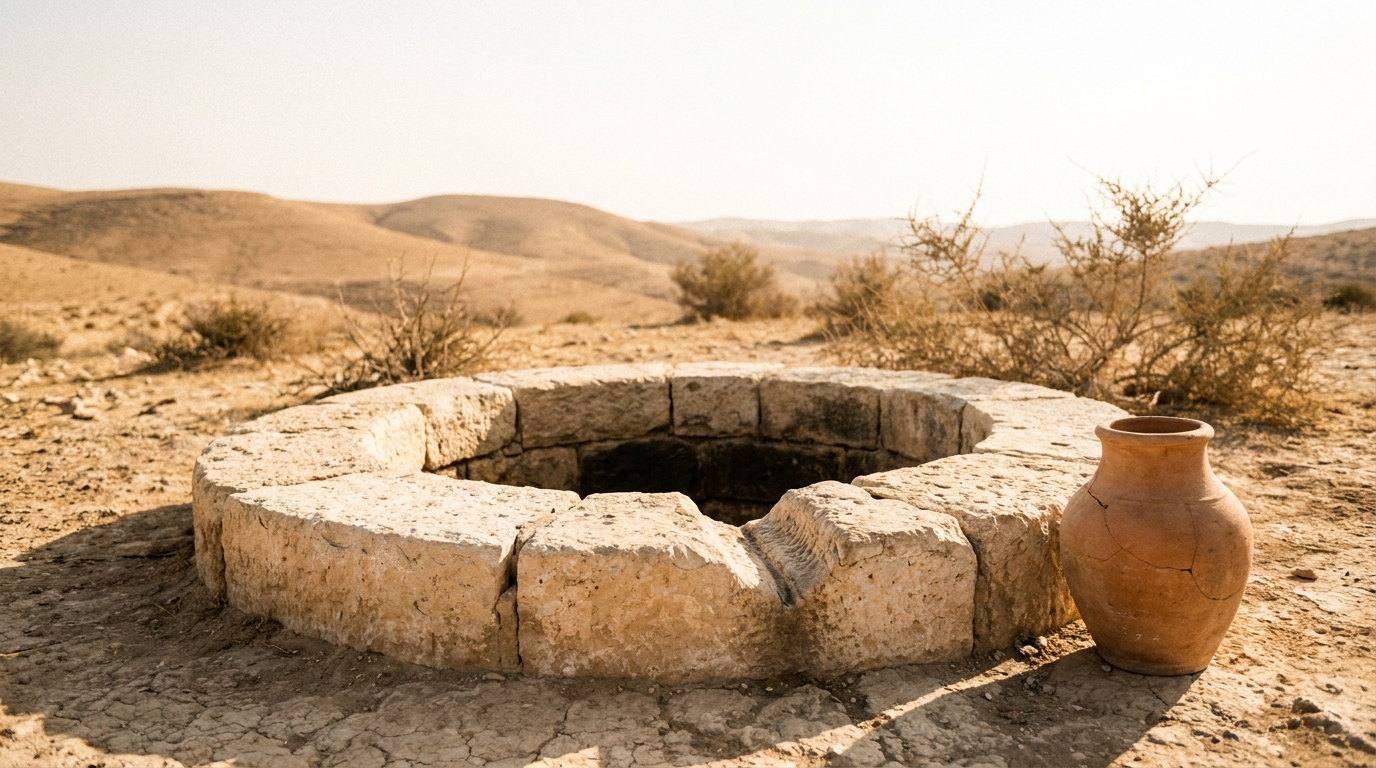
Then she pins it to the ground. The spring becomes Beer-lahai-roi (H883), the well of the Living One who sees me (Genesis 16:14). This is the practice at its plainest. Hagar heard God speak, and she recorded it, fastening the encounter to a place and a name so it could be found again by her and by everyone who passed that water after her. Naming the well is Hagar writing it down.
How does Hagar at the well point to Christ?
Centuries later, at another well, a tired traveller speaks first to another outsider woman and tells her the truth of her whole life (John 4:7-18). She leaves her water jar and runs to her town: "Come, see a man who told me everything I ever did" (John 4:29). It is the same shape. The God who sees, at a spring, meets the person the respectable world had written off, and sends her away seen and known, carrying news to her town. The thread that runs from Hagar's well to Jacob's well runs on to us.
Paul reads Hagar another way, as a picture of the flesh and the slave covenant (Galatians 4:24-25), the son secured by human scheming rather than by promise. Both readings are true, and they hold together. The covenant line runs through Isaac, the son God spoke into being; the tenderness of God still runs to Hagar, the woman that plan had wounded. God can refuse a scheme and chase down the person the scheme hurt, in the same chapter.
So Genesis 16 closes by teaching what its opening broke. To know the God who speaks is to know that He sees you first and hears the cry you never put into words, and then to hold onto it. Hagar met Him on the worst day of her life, running the wrong way, and she walked off with a name for God and a well she could return to. Do the same with your own encounters. When God finds you and speaks, name the place, write the date, keep the record, so that on the day you feel invisible you can go back to the water and read again that you were seen and heard.

Continue this pillar
Hear & Recognise


Next in the practice
Prophesy
Stewarding the words God gives you for others, and yourself.
Try Doxa free
Three free interactions in your browser. No signup required to start.Free on iOS and Android.
Try Doxa Free

Or get the app for unlimited interactions and live voice.
Keep reading
 Hear & Recognise
 Abraham Obeyed on That Very Day: Genesis 17 and the Exodus Night
Day thirty of a walk through the whole Bible to know the God who speaks, opened up. Genesis 17:15-27 in the original words: where the Hebrew verb behind Abraham's laugh runs next in Genesis, the verb hidden inside God's answer about Ishmael, what the law of the day said about a slave woman's son, and why 'on that very day' was the phrase Israel used for the night they left Egypt. How the book's first hearers heard their own exodus in their father's obedience.
 Hear & Recognise
 Why Did Abraham Laugh? God Names Isaac a Year Early (Genesis 17)
Day thirty of a walk through the whole Bible to know the God who speaks. Abraham falls facedown and laughs at the promise of a son at a hundred, then pleads for Ishmael, the son he can already see. God hears both, names the child Isaac, which means he laughs, and sets the date a year out. Genesis 17:15-27: why Sarai becomes Sarah, what 'I have heard you' does with Ishmael's name, and why Abraham obeyed on that very day.
From the Grace Record
Real accounts of what God has done, drawn from 2,000 years of believers.
 Samaria / Rome
 Justin Martyr: Philosopher Found True Wisdom
A Greek philosopher in 2nd century Rome searched through Stoicism, Platonism, and other philosophies before encountering Christianity.
Read the story Durban, KwaZulu-Natal
 Miracle of Healing in South Africa
During a 2025 South Africa crusade, Precious was miraculously healed from diabetes through prayer, along with a woman healed from kidney infection.
Read the story Leipzig, Saxony
 Johann Sebastian Bach - Every Note for God's Glory
Johann Sebastian Bach dedicated his entire musical genius to God's glory, writing 'Soli Deo Gloria' on his compositions and serving as a church musician.
Read the story